
Some evenings call for a village, a pot of tea and a murder that has the decency to happen offstage. Others call for a snowstorm, a remote chapel and a marriage that may not be what it seemed. The books are not interchangeable. Neither are the evenings.
Mystery novels are not my domain, if I am honest. I read them now and then for a relaxing time, and when I do I usually reach for something cozy: the English countryside, small village life, a crime that never quite disturbs my peace of mind. This autumn I read three, and they sit at three very different distances from the dark. A mystery makes a promise about atmosphere long before it makes one about the culprit, and choosing well is a small act of self-knowledge. How much darkness do I want tonight, and how close should it sit?
What Makes a Mystery Cozy
A cozy mystery, in the traditional sense, is a crime story with the edges softened: an amateur sleuth, a close-knit community, violence kept at a polite distance and order restored by the last page. A psychological thriller does the reverse. It keeps the edges sharp and the order uncertain. Between the two lies a wide and pleasant territory where the puzzle matters as much as the mood, and I found the best of it in the second book below.
For the Cozy Evening:
Agatha Raisin and the Quiche of Death by M.C. Beaton
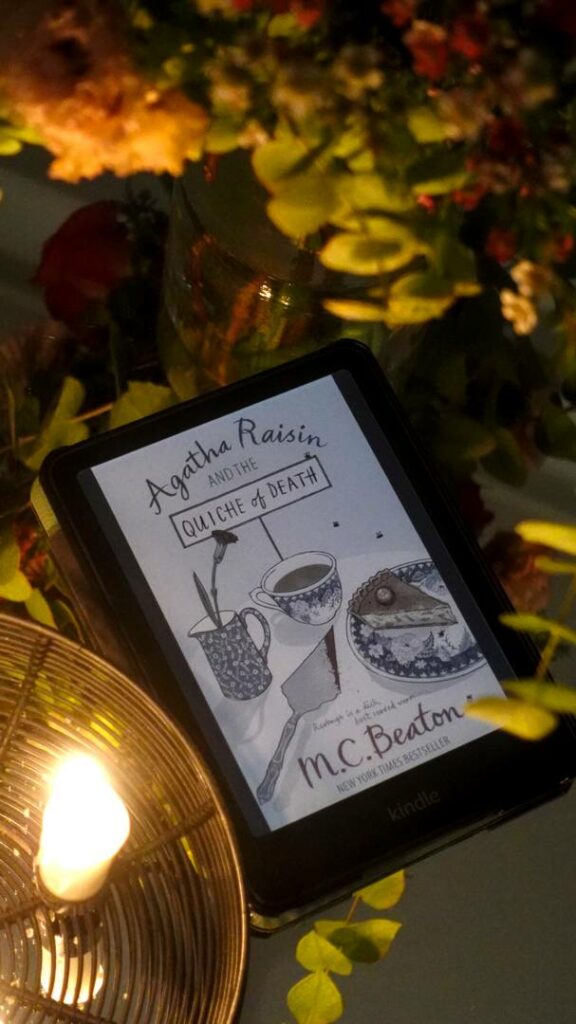
Agatha Raisin has left a career in London public relations for a village in the Cotswolds. She cannot cook. The village holds a quiche competition. So she buys a quiche in London and enters it as her own, and when the judge dies after tasting it, she sets out to find what really happened.
Reading it gave me the same feeling as a Hallmark movie, with a cozy British accent and the small-country-living atmosphere that goes with it. What I liked most is Agatha herself. You do not fall for her instantly. She is not the adorable, naive city girl who arrives in the countryside, solves the murder and lets everyone’s perfect life carry on as before. She is a little sly (though never dishonest enough to let a possible murder pass for an accident), and you get to know her slowly, which gives her more depth than the genre usually offers.
It is a good opening for readers who love the village novels of Miss Read and would like a bit more mystery, without anything gloomy or sad. A textbook cozy read, light enough that it could even work for young adults, and for the reader who wants a very small dose of mystery and a large one of atmosphere.
Read it when the week has been loud and you want order restored by the final page.
Pair it with a pot of tea and a slice of something savoury (ideally one you baked yourself, given the circumstances).
For the Curious Evening:
A Murder of Crows by Sarah Yarwood-Lovett
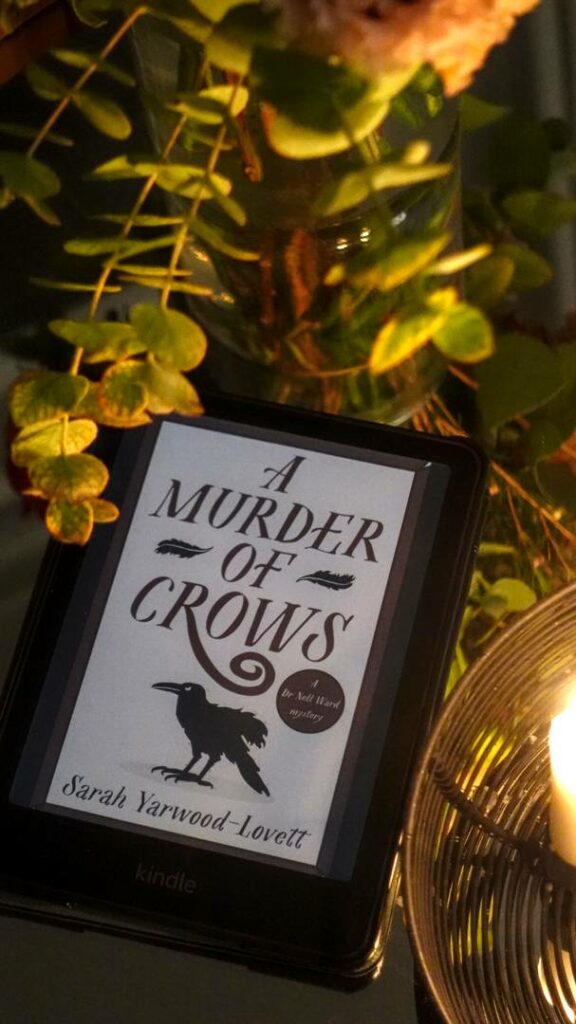
This is the first of the Dr Nell Ward mysteries. Nell is an ecologist in a quaint English village, and when a murder turns her working life upside down she finds herself under suspicion and reluctantly becomes an amateur sleuth.
This one surprised me. I did not know the author and had no expectations, and the first chapter had me hooked. It remains a cozy mystery in the ways that count: the tension and violence stay moderate, the setting is the British countryside I love, and it will not give you nightmares. But it is so well written that it is the kind of book you devour in two days because you need to know what happened, and you truly cannot guess how it ends. It is relaxing and gripping at once, which is a rarer combination than it sounds. I have already bought the next one in the series.
I call it the curious evening because the puzzle leads. The mood stays gentle while your mind gets real work to do.
Read it when you want to escape reality for a while and dive into the story completely.
Pair it with a walk beforehand, so you start the evening already noticing things.
For the Chilling Evening:
Rock Paper Scissors by Alice Feeney

A couple sets off for a weekend in the Scottish Highlands, a last attempt to repair a troubled marriage. They arrive through a snowstorm at a remote chapel. I will stop there, because with Alice Feeney the less you know the better.
This was my second Feeney, and both times I listened to the audiobook. The narration was a real part of the pleasure, with Richard Armitage and Stephanie Racine giving the story two distinct and haunting voices. It is undeniably the darkest of the three, and the tension is almost unbearable. What I admired most is what she does to your mind. With every chapter you believe you know the characters a little better, you begin guessing who did what and where the truth lies, and in reality you grow more confused. That is not an easy thing to do as a writer, and it is clearly one of her trademarks, because I recognised it from Beautiful Ugly, the first of her novels I read last year. In a way it reminded me of John Fowles’s The Magus, which is a high compliment in my book. The ending is unpredictable, which is always the mark of a good mystery.
Do not try to control anything. Let the author take you wherever she wants, because she is an expert, and for me, a master of the psychological thriller.
Read it when you are ready to be unsettled and have a lamp within reach.
Pair it with a heavy blanket and a free morning, because you may not want to stop.
Choosing Your Evening
If I had to name a winner for craft, it would be Alice Feeney, who plays with a reader’s perception better than anyone I have read in the genre. If I had to name the book I will recommend most often to friends, it would be A Murder of Crows, the passe-partout of the three (my idea of a book that suits almost everyone). Agatha Raisin is for the atmospheric reader, the one who wants cozy first and a gentle puzzle second.
The nights are drawing in, and a mystery is one of the oldest ways of meeting the dark with a cup in your hand.
So which evening is it tonight?

Written by Alexandra Poppy
Writer, reader & curator of The Ritual of Reading
I’m Alexandra, the voice behind The Ritual of Reading. Somewhere between a stack of novels and a half-finished pot of tea, I keep finding traces of the life I want to live—slower, richer, filled with stories. The Ritual of Reading is where I gather what I love: books that linger, places with a past, and rituals that make ordinary days feel a little more meaningful. I write from Paris, where elegant bookshops and old-fashioned cafés offer endless inspiration—and I share it here, hoping it brings a spark to your own days, too.
Enter The Ritual of Reading
Each Sunday, receive a letter to steady your attention—literary inspiration, seasonal rituals and reflections from a life shaped by books.
On the first of each month, a gift: The Literary View, a custom wallpaper created to accompany your days.