
There are seasons of the body and seasons of the spirit. Right now mine are out of sync.
Spring is doing what spring does. The markets are filling up, the asparagus has arrived, the artichokes are back with their armoured, slightly forbidding beauty. Ingredients I genuinely love. And yet I keep finding myself standing in front of all of it with my hands in my pockets, looking rather than reaching. Something has gone quiet. Not the appetite exactly; it’s more like a disconnection from it, a glass pane between me and the things I usually want.
When the Appetite Goes Quiet
I know this feeling. It comes after periods of depletion, when you’ve been giving out more than you’ve been taking in and haven’t quite noticed until the body makes it impossible to ignore. A recent health episode, a gastritis flare that arrived at the most ironic possible moment just as I was preparing to write about food, confirmed what was already true. I had been running on empty for a while. The stomach is not a patient organ, and it had finally made itself heard.
The trouble with this kind of disconnection is that you can’t force your way out of it. Standing in the kitchen and commanding yourself to feel inspired doesn’t work. I’ve tried. What works, what has always worked for me reliably, almost embarrassingly, is reading. Borrowing someone else’s hunger. Following a fictional character into a kitchen so vividly rendered that something in me wakes up in recognition, and before I’ve quite registered what’s happening I’m reaching for the artichoke after all.

Borrowing Someone Else’s Hunger: The Alchemy of Food Writing
Food writing does something I find almost inexplicable, even after years of reading it: it makes the imagination edible. A well-described dish doesn’t just conjure flavour; it conjures a whole emotional state, a whole way of being present in one’s own life. The five novels below have all, at different moments, done exactly this for me. None of them are cookbooks. One or two don’t contain a single recipe. But every one of them has sent me back to the kitchen wanting to cook something.
5 Novels to Restore Your Culinary Spirit
The Restaurant of Love Regained by Ito Ogawa
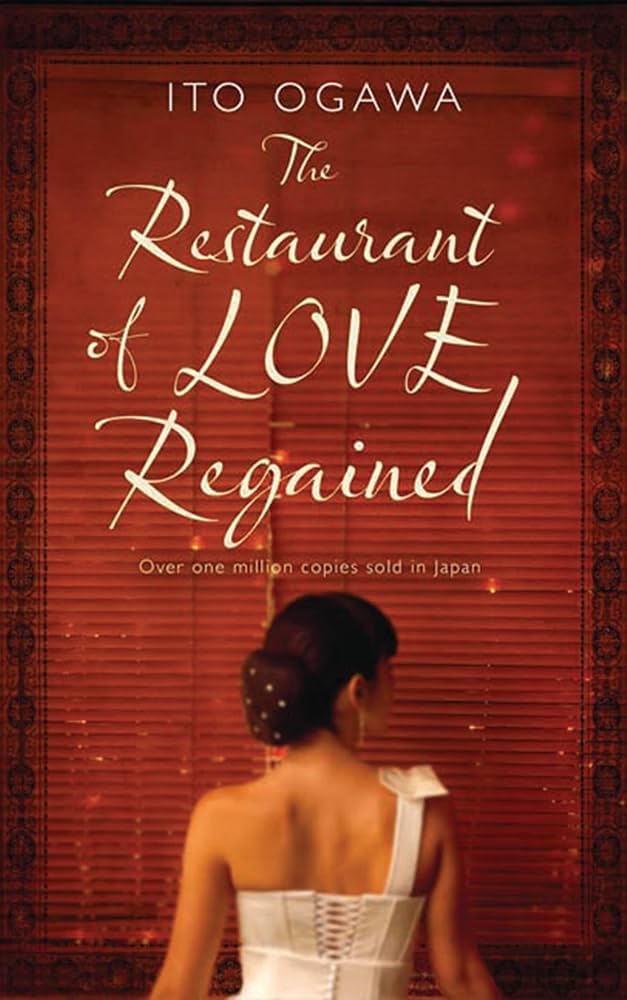
There is a particular quality to Japanese literary minimalism that I find very hard to describe and very easy to feel. It works not by saying less, exactly, but by leaving space, a deliberate spaciousness on the page that the reader fills with something of their own. Ito Ogawa’s novel has this quality in abundance. It is a small book. It doesn’t announce itself. And it stays with you for a long time.
Rinco is a young woman who has built her life around cooking and around love, and loses both in the same moment when her partner leaves without a word, taking her voice along with him, literally, in the way of the best magical realism: she wakes up and cannot speak. She returns to the small rural town she had left behind, to a mother she has a complicated history with, and slowly, almost accidentally, opens a restaurant. One table. One guest per sitting. One meal, designed entirely around the person who has come to eat it. She studies her guests beforehand, reads them the way you read a text, trying to understand what is really being asked for underneath the surface. Then she cooks for them. It is a profoundly tender premise, and Ogawa handles it without sentimentality, which is exactly why it works. Food, in this novel, is language. It is what Rinco says when she can say nothing else. Reading it changed something small but real in how I think about cooking: not as a practical task or even as a pleasure, but as a form of attention, a way of saying I see you, I thought about you, this is for you specifically. That is not a small thing.
The School of Essential Ingredients by Erica Bauermeister
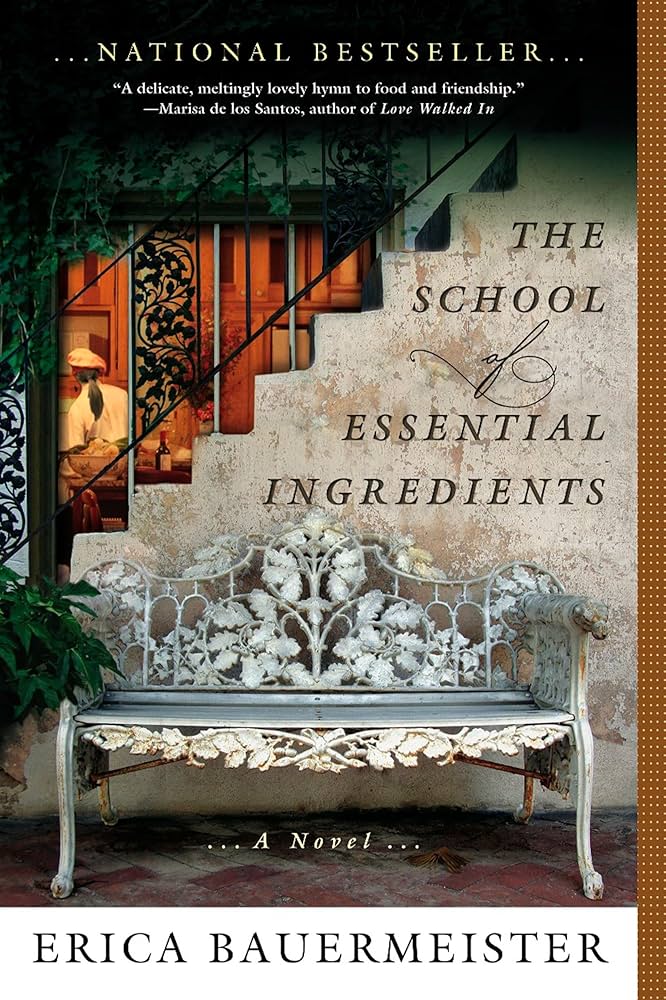
Eight people, a Monday evening cooking class, a restaurant kitchen, a teacher named Lillian who chose this life deliberately and knows exactly what she is doing. On the surface it is a simple premise. What Bauermeister builds from it is something much quieter and stranger: a novel about how we carry our histories in our bodies, and how the act of cooking, the physical attention it demands, can reach parts of us that other forms of attention miss entirely.
Each chapter belongs to a different student, and each student is carrying something, a loss, a longing, a relationship in some state of difficulty or transition. Bauermeister doesn’t rush any of them. She gives each person the space to be complicated, and she trusts the reader to stay with the slow revelation of who they are and what they need. What holds the whole thing together is the writing about food itself, which is some of the most genuinely sensuous I’ve encountered. She describes the smell of caramelising onions and a character’s grief in the same register, with the same quality of close attention, because she understands, and quietly insists, that they are not separate categories of experience. The body knows things. The kitchen is a place where the body gets to say them. By the final chapter, the novel has the feeling of a meal that was composed with real thought, each element chosen, each course leading somewhere. I finished it wanting to cook, yes, but also just wanting to pay better attention. To the ingredients in front of me. To the people I cook for.
Pomegranate Soup by Marsha Mehran
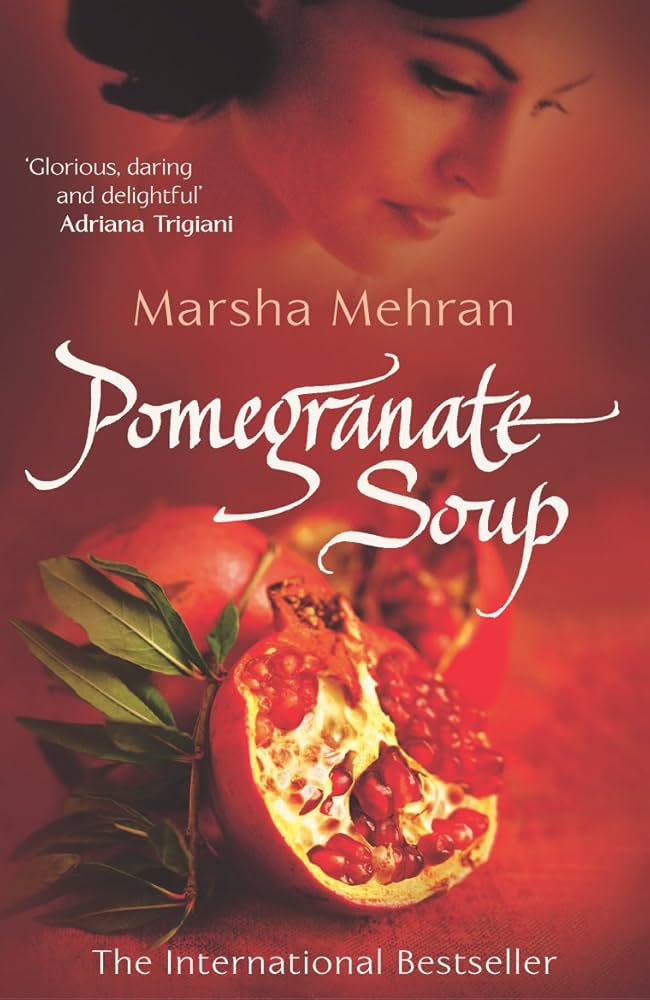
This one holds a particular place for me, and I’ll be honest about why: Persian food is not a cuisine I came to through books. It came to me through life, through people, through the experience of sitting at tables where the cooking told you something immediate and important about who had made it and where they came from. So when a novel gets Persian food right, the saffron, the dried limes, the layering of sweet and sour and fragrant that characterises so much of that cuisine, I notice. And Mehran gets it right.
Three Iranian sisters arrive in a small Irish village and open a café. They have left everything behind. What they bring with them, what cannot be confiscated at a border or lost in transit, is what they know how to make. The Babylon café fills the village with aromas it has never encountered before: rosewater and advieh, pomegranate and barberry, the deep gold of saffron broth. The village, being fictional and therefore capable of the grace that real villages sometimes lack, slowly opens to them. Mehran’s novel is warm and slightly eccentric and enormously generous, which is also the best description of the food at its centre. Real recipes appear between the chapters, and they are worth cooking, not as novelties but as proper dishes, the kind you return to. I know this because this book sent me straight into the kitchen, inspiration directly onto the plate. I made a Persian recipe that had been waiting in the back of my mind for exactly this kind of invitation. If you’d like to cook alongside your reading, you’ll find the recipe right here.
Gourmet Rhapsody by Muriel Barbery
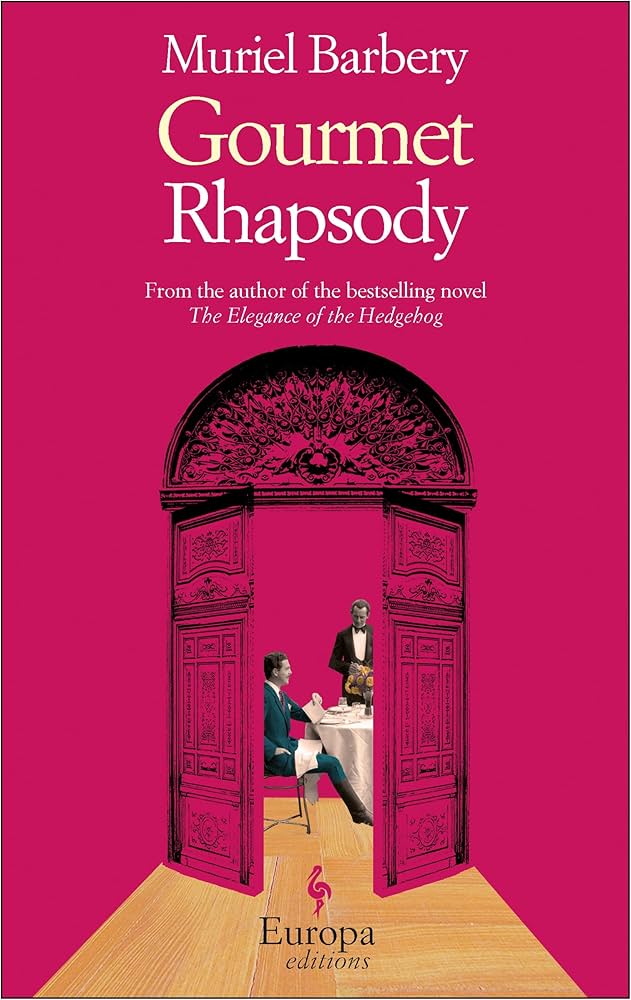
Before The Elegance of the Hedgehog, there was this: a dying food critic, Pierre Arthens, lying in his Parisian apartment, working his way back through a lifetime of meals in search of one particular flavour. He can’t name it. He can’t place it. But he is certain it exists, some taste from long ago that contains, he believes, the secret meaning of his entire life, and he is running out of time to find it.
The novel is narrated in fragments: Arthens himself, in an interior monologue of almost unsettling culinary precision, and then the people around him, wife, children, neighbours, each offering a slightly different, often damning account of who he really is. He is not a likeable man. Self-absorbed, cold, capable of cruelties both large and small toward the people who love him. Barbery doesn’t ask you to forgive him for any of it. What she does instead is stranger and more interesting: she makes his obsession genuinely, almost painfully moving. Because the thing Arthens is really searching for isn’t a flavour. It’s a feeling. The feeling of being completely, undeniably alive, present in his own experience in a way that his whole cultivated, pleasure-filled life never quite managed to deliver. It is a deeply French novel. I mean that as a compliment. It takes the life of the senses completely seriously, as a philosophical matter, not a frivolous one, and it asks, quietly and without resolution, whether a life spent in pursuit of beauty is a life well lived, or simply a life well distracted. I’ve thought about that question more than once since finishing it.
Little Beach Street Bakery by Jenny Colgan
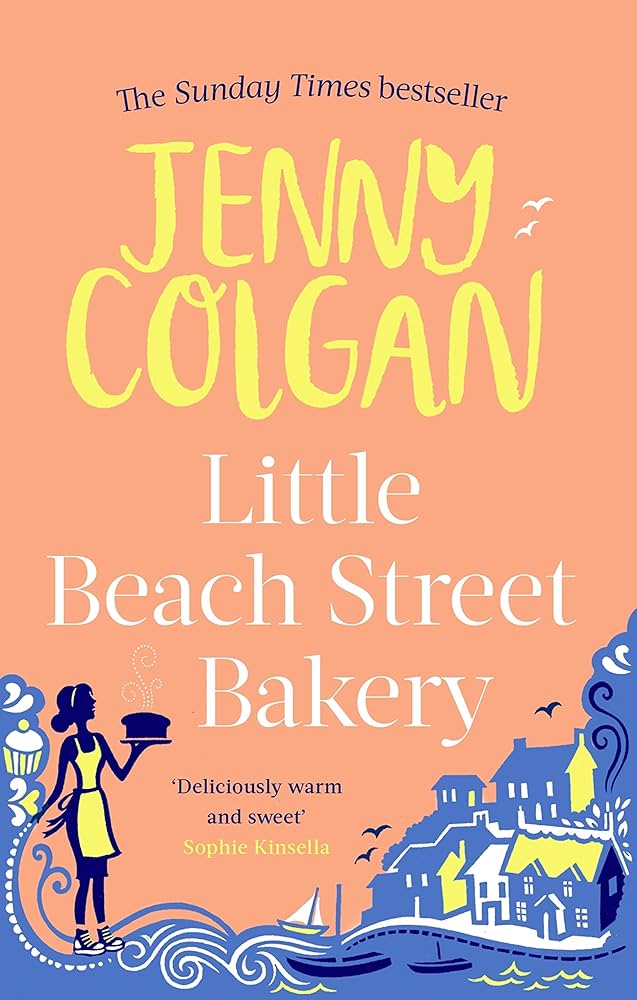
I want to be straightforward about why this novel is on this list alongside Barbery and Ogawa, because they are not operating in the same register and there’s no point pretending otherwise. Colgan writes warm, funny, commercially successful fiction set in beautiful locations. She is very good at it. And this is not a lesser thing.
Polly Waterford arrives in a crumbling Cornish tidal village having lost nearly everything: her relationship, her business, her sense of what comes next. She begins to bake bread almost by accident, out of restlessness more than intention, and gradually discovers that this accidental practice is the thing that gives her days their shape and their pleasure. What I like about the novel is how seriously Colgan takes the bread itself. The weight of a properly made loaf, the smell of yeast, the small daily transformation of dough; she writes about it with real affection, and that affection is contagious. The book has the quality of the thing it describes. It is honest and sustaining and made with care. There are moments in a reading life, and certainly in a life, when you don’t need to be challenged. You need to be accompanied. To be reminded, gently, that small pleasures are real and that building something with your hands is worthwhile and that a fresh start is not a fantasy. This book does that. I think of it as the literary equivalent of a good loaf on a grey morning: not the most complicated thing you’ll ever taste, but exactly what was needed, and better than you expected.
The Extraordinary Power of Fictional Appetite
I have been thinking about what it means that a fictional character, someone who was never born, never stood in a market not knowing what they wanted, never experienced the particular defeat of a gastritis flare in the springtime, can nonetheless lead you back to your own appetite. It shouldn’t work, rationally. And yet it does, reliably, every time.
I think it’s because we are more porous than we like to admit. We absorb the inner lives of characters we love. Their desires become briefly available to us; we feel, through them, what it is like to want something completely, to be lit up by a flavour or a smell or the particular pleasure of a meal that was made with you in mind. And in feeling it through them, we remember that we are capable of it ourselves. The feeling isn’t gone. It was just waiting for the right story to call it back.
That’s what these five novels have done for me, at different points and in different ways. Not instructed me. Not inspired me in the motivational sense. Just reminded me, quietly, through the medium of someone else’s fictional hunger, that my own is still there. That the kitchen is still there. That the asparagus is in the market and the artichokes are coming and there is no good reason, really, not to reach for them.
So I’m going back in. I hope you’ll join me.
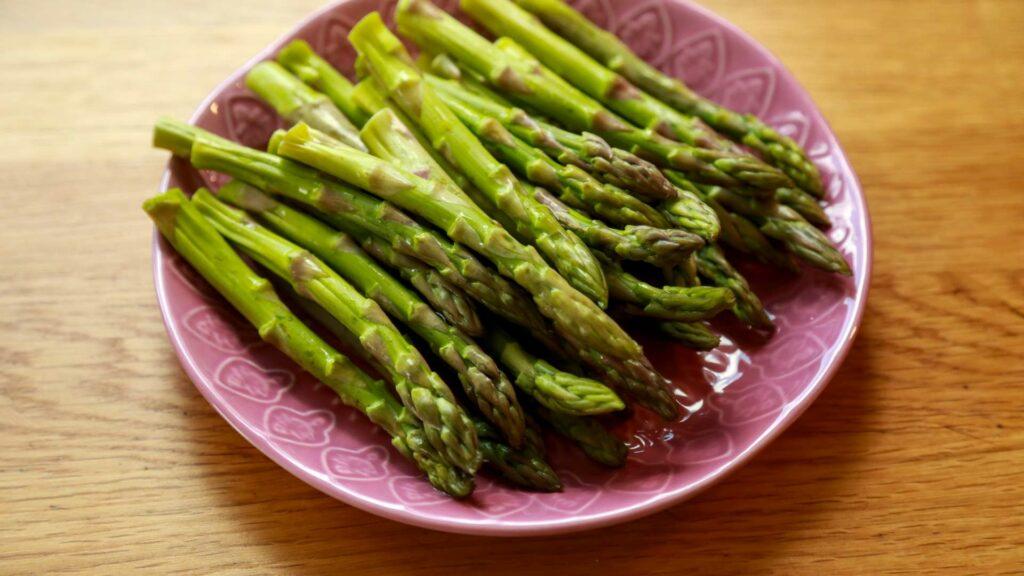
Speaking of asparagus: if this post has done its job and sent you toward the kitchen, I have just the recipe waiting for you. A spring green salad that itself began as a reading experience, crisp and bright and very much of this season. Find the Signature Green Salad here.

Written by Alexandra Poppy
Writer, reader & curator of The Ritual of Reading
I’m Alexandra, the voice behind The Ritual of Reading. Somewhere between a stack of novels and a half-finished pot of tea, I keep finding traces of the life I want to live—slower, richer, filled with stories. The Ritual of Reading is where I gather what I love: books that linger, places with a past, and rituals that make ordinary days feel a little more meaningful. I write from Paris, where elegant bookshops and old-fashioned cafés offer endless inspiration—and I share it here, hoping it brings a spark to your own days, too.
Enter The Ritual of Reading
Each Sunday, receive a letter to steady your attention—literary inspiration, seasonal rituals and reflections from a life shaped by books.
On the first of each month, a gift: The Literary View, a custom wallpaper created to accompany your days.