
Visiting Le Bon Marché, Montmartre Fabrics, and the World of Au Bonheur des Dames

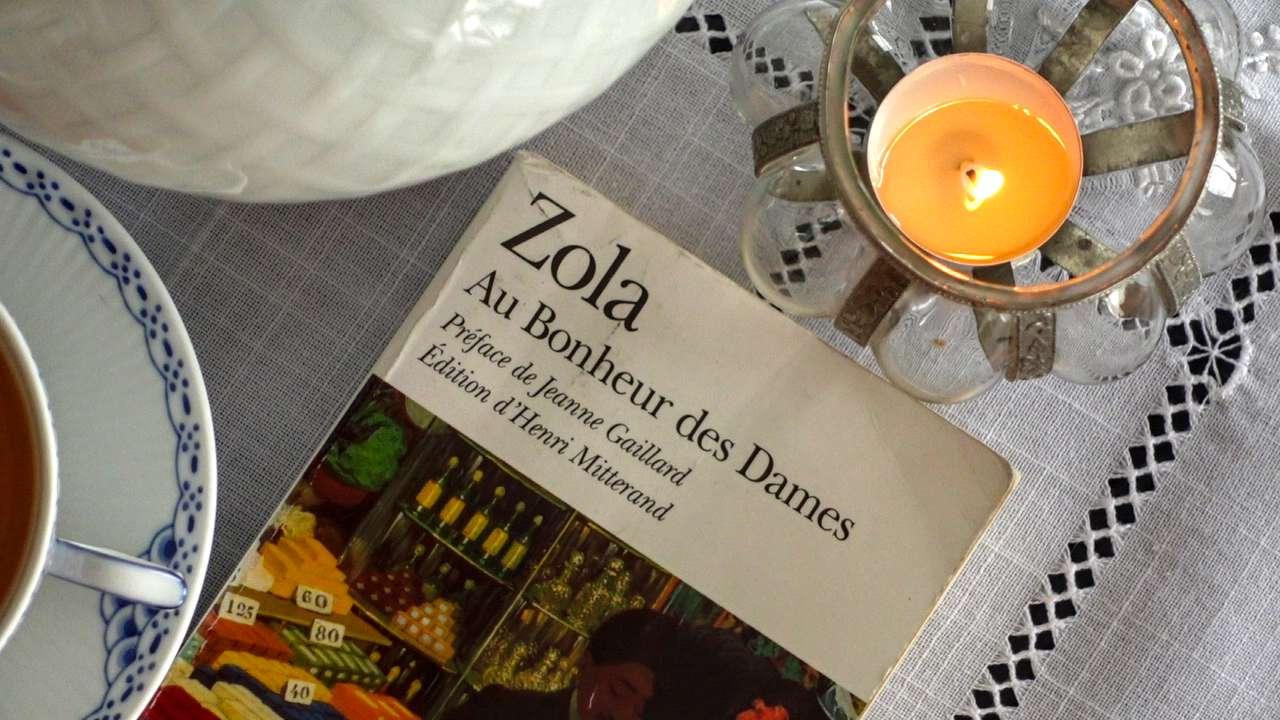
Taking my books out for a walk seems like the perfect autumnal ritual, and when you pair a French classic with Paris, the combination is pure magic. This October was a return to French classic authors for me—a proof that revisiting old demons can sometimes reveal new favourites. For years, I’d considered Émile Zola’s writing to be too dark for my taste, but I’m grateful I gave it another shot. Revisiting Au Bonheur des Dames translated into English as The Ladies’ Paradise revealed another side to his style entirely, one that felt surprisingly contemporary, even thrilling.
The Ladies’ Paradise follows Denise, a young woman from the provinces who arrives in Paris with little more than determination and a sense of duty to her struggling family. She finds work as a shop assistant in the grand department store of the title, where she witnesses firsthand the intoxicating power of commerce, the ambition of the store’s visionary owner Mouret, and the tension between progress and tradition. As the store grows into an empire, consuming smaller shops and transforming the city around it, Denise navigates love, loyalty, and her own quiet resistance to the machinery of desire. It’s a novel about transformation—of the city, of commerce, of individuals caught in the wake of unstoppable change.
A Novel Born from History
To truly understand Zola’s vision, I needed to walk through the very world he chronicled. Au Bonheur des Dames isn’t mere fiction—it’s a portrait of a seismic shift in Parisian society, one marked by the rise of the grand department store. These weren’t just shops; they were temples of progress, symbols of modernity that would reshape urban life forever.
The timeline speaks for itself: Au Bon Marché opened in 1838, followed by Printemps in 1865, La Samaritaine in 1869, and Galeries Lafayette in 1895. Across Europe and America, similar palaces of commerce were rising—Macy’s, Saks Fifth Avenue, Liberty, Harrods, Selfridges. Yet Paris led the way. These were architectural marvels, designed to overwhelm the senses: soaring glass domes, exquisite interiors, each detail calculated to dazzle shoppers and draw them deeper into temples of desire. These stores represented thrilling progress, yet they carried an undeniable cost: the slow extinction of small commerce, the livelihood of independent shopkeepers vanishing almost overnight. It’s a wheel that may be turning again, as we find ourselves, more recently, attempting to return to a sense of ethics in buying—supporting small business owners and local products once more.


Stepping Into Le Bon Marché
Le Bon Marché, the very inspiration for Zola’s novel, still stands as an elegant monument to that era. As I crossed its threshold, I was greeted by a shop assistant with the formal courtesy of another age: “Soyez la bienvenue au Bon Marché“—something infinitely more elaborate than a simple welcome. Perhaps it translates best as: May you feel most warmly welcomed to Le Bon Marché.
Walking through its halls, I found myself immersed in the very descriptions Zola had brought to life on the page. Yet what struck me most was what had changed. In his novel, when it came to clothing, the focus was relentlessly on the origin and quality of textiles and supplies—never on brands, and very little accent on ready-made garments. How different from the department stores of today. The deliberation, the craftsmanship, the relationship between material and maker—all of this felt suddenly precious, almost lost.

In recent years, Le Bon Marché added a luxury food department in an adjacent building, and it’s become one of my regular haunts. I spend hours there, wandering between the international displays of exquisite products—not always buying, but absorbing. There’s something about seeing what exists in the world, the abundance of carefully sourced ingredients and artisanal creations, that gives my creativity a profound boost. It’s a modern echo of what drew Zola’s characters to the original store: the promise that beauty and quality exist somewhere, waiting to be discovered.
The Language of Textiles
To truly retrace the vivid descriptions in Zola’s work, I ventured to Montmartre, to the Marché St Pierre neighbourhood, where fabric shops still hold the atmosphere of another era. One particular shop, dating back to the 1940s, carried echoes of my own childhood memories—though my small-town fabric shop wasn’t even a tenth of this place’s size. Floor after floor of endless fabrics, all colours and textures: the most natural silks and cottons alongside modern inventions of polyester and faux fur. It’s a heaven for the creative mind.

There is something profoundly tactile about wandering through a space like this, something we’ve lost in our age of mass-produced retail clothing. The pleasure of a quality fabric, the delight of a pattern before it even takes shape into a finished piece, the beauty of human imagination and artisanry—the time spent imagining what thousands of meters of cloth could become. It’s the fine dining versus fast food debate all over again, something Zola observed and underlined with exceptional finesse.
The Psychology of Desire
What surprised me most upon rereading Zola was how prophetic his observations truly are. His keen eye for the psychology of shopping anticipated modern marketing by more than a century. In an age of internet algorithms that study our every move to offer us products we didn’t even know we needed, Zola’s words feel startlingly contemporary. Consider this passage, where he captures the distinct nature of five different women encountering the same silk:

“Ever since the advertisements had been launched, this silk had come to occupy a remarkable place in their daily lives. They talked of nothing else, promising it to themselves, torn between desire and hesitation. And beneath the lively chatter with which they besieged the young man, their distinct natures as shoppers gradually revealed themselves. Madame Marty, swept away by her passion for spending, bought everything at The Ladies’ Paradise, without discernment, seizing whatever caught her eye on the counters. Madame Guibal, on the contrary, would stroll there for hours without making a single purchase, content and delighted to grant her eyes a harmless pleasure. Madame de Boves, always short of money and consumed by an envy too great to appease, bore a secret grudge against the goods she could not afford to take home. Madame Bourdelais, with the shrewd instinct of a sensible, practical housewife, went straight for the bargains, using the great store with such calm and skilful economy that she managed to save handsomely. And finally Henriette—graceful and elegant—bought only certain things in the store: her gloves, a few items of hosiery, and all her household linen.”
These aren’t mere character sketches. They’re archetypes of consumer behaviour, categories that still ring true today. Zola understood the machinery of desire, the way a store could orchestrate longing and satisfaction with almost mathematical precision. He spent a year documenting the daily life of Le Bon Marché, he wrote newspaper articles with his observations, before finally taking on the novel itself, writing it secluded in his country home for eight months.

The Bitter-Sweet Truth
What captivated me most about revisiting Zola was his fundamental ambivalence toward the changes he witnessed. The contrast between the joy of customers in a paradise of merchandise and the misery of old-world shopkeepers losing their livelihood is a classic Zola theme. One might assume he was resisting progress, constantly remarking on its negative consequences. But I believe he was genuinely fascinated by the times he lived through—captivated by an era where dazzling progress and devastating loss arrived side by side, inseparable.
There is undoubtedly a bitter-sweet feeling to his novel, yet reading it felt like watching a well-directed film. I found myself following the store as it grew larger and larger, empathizing with Denise as she navigated this new world while remaining tethered to her family’s struggles. The pace felt modern—exciting, propulsive, surprisingly contemporary. Perhaps my viewing of the British television series Mr Selfridge had shaped my perception, but the novel felt less like a historical document and more like a living, breathing chronicle of transformation.

The Walk Continues
Walking through Le Bon Marché, then through Galeries Lafayette and Printemps, I was struck by how these temples of commerce still carry their original magic—even if the goods have changed, even if we now grapple with the ethics of what we buy. And in the fabric shops of Montmartre, I found something Zola clearly understood: that there is still profound beauty in the deliberate act of choosing, in touching quality materials, in imagining possibility before it becomes product.
His novel isn’t a lament for the past or a warning against the future. It’s something more nuanced—an observation that progress and loss, excitement and precarity, human aspiration and economic upheaval, all arrive together, inseparable. Walking his Paris, reading his words, I felt less like I was visiting history and more like I was witnessing something eternally true about desire, commerce, and what we seek when we step into a space designed to make us want.
And I’m grateful—grateful to have rediscovered a classic with new eyes, and through it, to have spent time in my city with a fresh perspective on something as ordinary as shopping. Sometimes all it takes is the right book, the right season, and the willingness to look at the familiar world around you as though you’re seeing it for the first time.
Until next time, enjoy your reading and your autumn wanderings through the city.

Written by Alexandra Poppy
Writer, reader & curator of The Ritual of Reading
I’m Alexandra, the voice behind The Ritual of Reading. Somewhere between a stack of novels and a half-finished pot of tea, I keep finding traces of the life I want to live—slower, richer, filled with stories. The Ritual of Reading is where I gather what I love: books that linger, places with a past, and rituals that make ordinary days feel a little more meaningful. I write from Paris, where elegant bookshops and old-fashioned cafés offer endless inspiration—and I share it here, hoping it brings a spark to your own days, too.