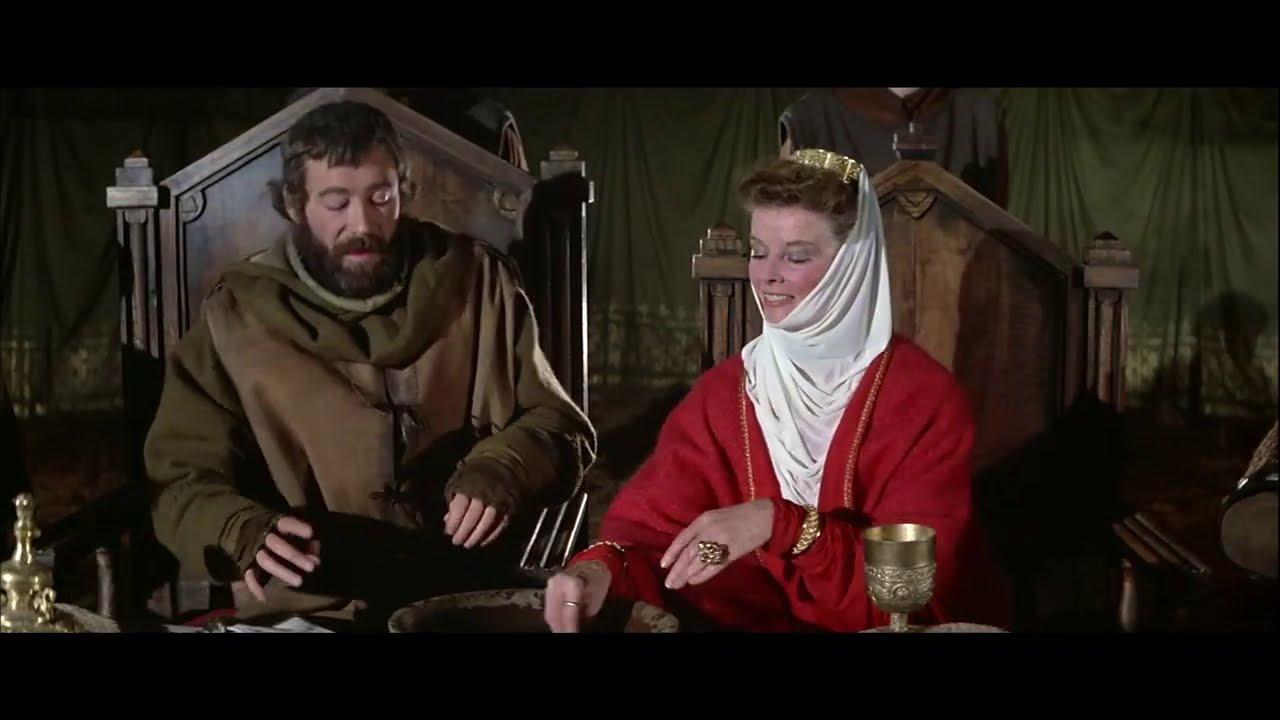
Medieval Advent Calendar Day 18
Hello, dear friends, and welcome back to our Medieval Advent Calendar. Today we’re teleporting ourselves to Christmas 1183, to the fortress town of Chinon in the Loire Valley—not with a book for once, but with a film. Specifically, the 1968 historical drama The Lion in Winter, starring Katharine Hepburn as Eleanor of Aquitaine and Peter O’Toole as Henry II of England.
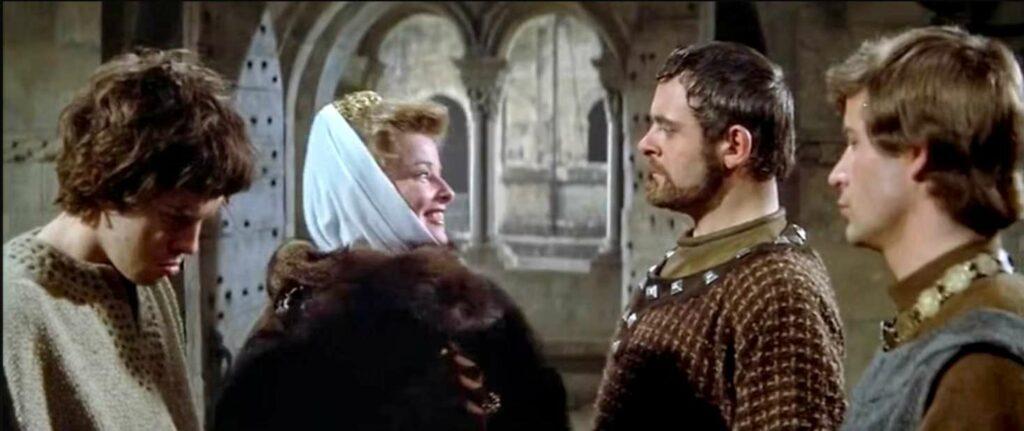
The film adapts James Goldman’s 1966 stage play, which sadly never achieved great success during its Broadway run. Goldman’s work is historical fiction in the truest sense: there are no contemporary records of a Christmas court at Chinon in 1183, yet the events leading up to the story are generally accurate. Fifty-year-old Henry seeks to establish a clear line of succession and summons his fractured family to spend Christmas at his castle. He favors his youngest son, John, as his heir, while his estranged wife Eleanor—temporarily reprieved from her English imprisonment for the holiday—champions their eldest surviving son, Richard, a proven warrior and her clear favorite. The presence of Philip II, King of France, further complicates matters, as his half-sister Alais resides at Henry’s court as his mistress while remaining officially betrothed to Richard. The stage is set for three days of psychological warfare disguised as family celebration.
You can feel the play’s theatrical bones in every scene, and viewers less familiar with stage conventions—or younger audiences without the context of classic cinema—might find the rhythm somewhat weighted, even slow. I think our reasons for watching films have changed radically between 1968 and 2024. We’ve grown accustomed to visual spectacle and rapid pacing, while The Lion in Winter offers something increasingly rare: extended scenes of brilliant verbal sparring, characters who speak in complete, eloquent sentences, conflicts resolved through wit rather than action.
Historical adaptations represent a niche with very specific codes, which might explain the polarized reviews when the film was released—you either loved it passionately or found it unbearable. I find Roger Ebert’s assessment perfectly aligned with my own experience: “One of the joys which movies provide too rarely is the opportunity to see a literate script handled intelligently. The Lion in Winter triumphs at that difficult task; not since A Man for All Seasons have we had such capable handling of a story about ideas. But The Lion in Winter also functions at an emotional level, and is the better film, I think.”
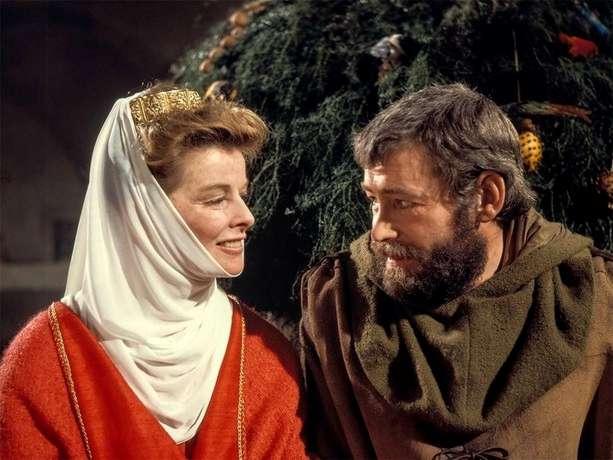
Nominated for seven Academy Awards and winner of three, this film earned Katharine Hepburn her third Oscar—and for me, it remains her most memorable role. Her Eleanor is the definitive interpretation: strength and vulnerability combined in a single, devastating gaze. She was sixty years old at the time of filming, perfectly prepared to incarnate the symbol of an era—the decisive woman of state, the calculating mother, the woman still in love despite her better judgment. I imagine that last part wasn’t terribly difficult to portray with Peter O’Toole as her scene partner. Despite the twenty-five years between them in real life, they maintained the symbolic age difference between Henry and Eleanor while managing to resurrect legends that had nearly faded from cultural memory.
Their chemistry crackles through every confrontation. These are two people who know each other with exhausting intimacy, who can wound with surgical precision because they understand exactly where the other is vulnerable. Yet beneath the cruelty runs an undercurrent of genuine feeling—not the simple romance of their youth, but something more complicated and durable. They are locked together not just by marriage and politics but by the terrible shared knowledge of who they truly are.
Take this as an invitation to revisit a classic this holiday season. There’s a double time-travel experience to be enjoyed alongside your popcorn: backward to the twelfth century and backward again to 1968, when films still trusted audiences to follow complex dialogue and sit with characters rather than simply watch things happen to them.
Until tomorrow, dear friends—merry Advent, and may your viewing be as richly layered as this remarkable film.

Written by Alexandra Poppy
Writer, reader & curator of The Ritual of Reading
I’m Alexandra, the voice behind The Ritual of Reading. Somewhere between a stack of novels and a half-finished pot of tea, I keep finding traces of the life I want to live—slower, richer, filled with stories. The Ritual of Reading is where I gather what I love: books that linger, places with a past, and rituals that make ordinary days feel a little more meaningful. I write from Paris, where elegant bookshops and old-fashioned cafés offer endless inspiration—and I share it here, hoping it brings a spark to your own days, too.