
Belgian Advent Calendar – Day 9
You cannot speak of Belgium without speaking of Art Nouveau. It would be like describing Paris without mentioning Haussmann’s boulevards, or Venice without her canals. Art Nouveau isn’t just an architectural style here—it’s the very signature of Brussels, the visual poetry that winds through her streets like tendrils of iron and glass.
So when I set out to explore Brussels properly, choosing at least one Art Nouveau mansion to visit was inevitable : I opted for the Maison Hannon. And what I found there exceeded even my most romantic expectations.
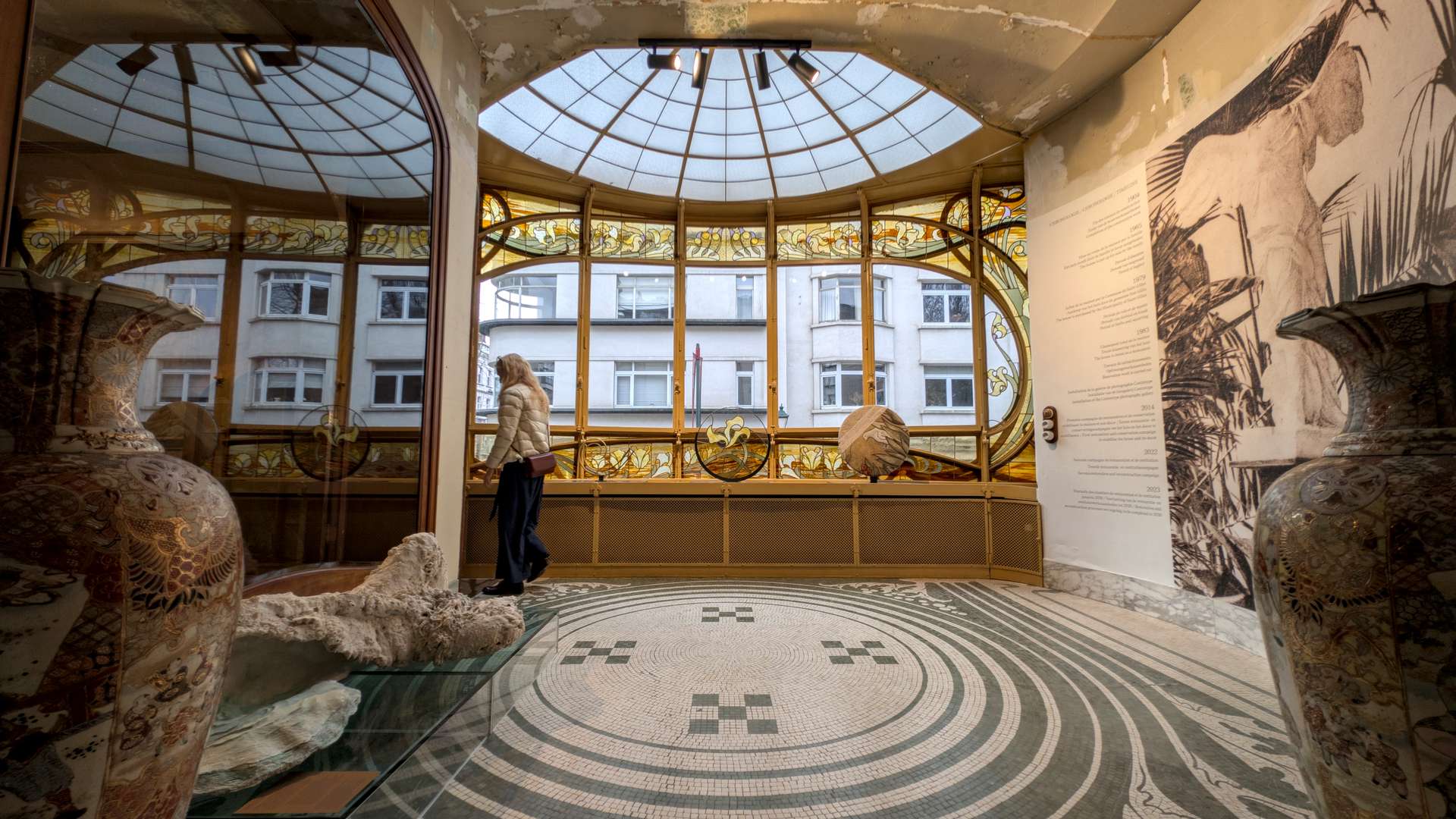
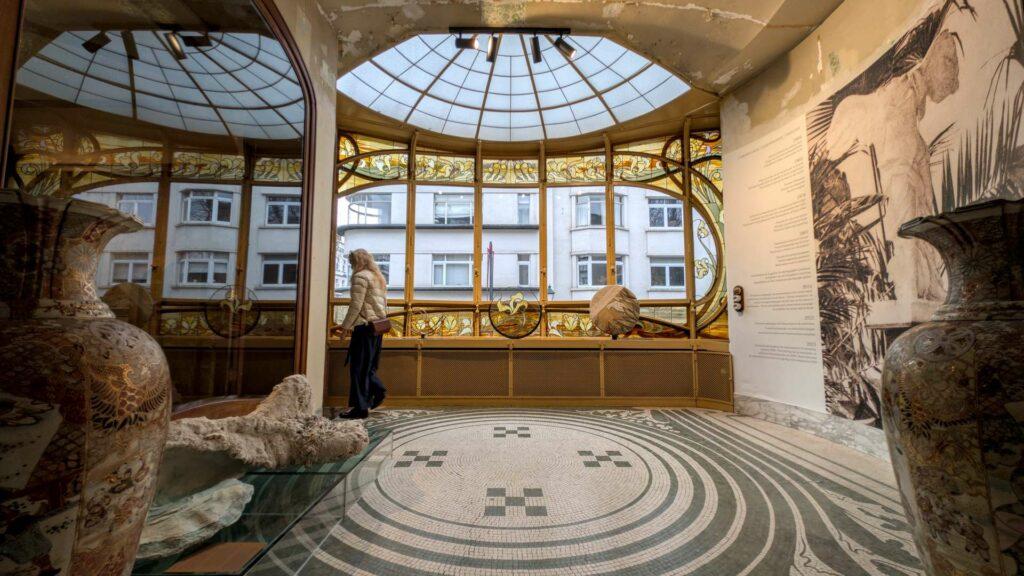
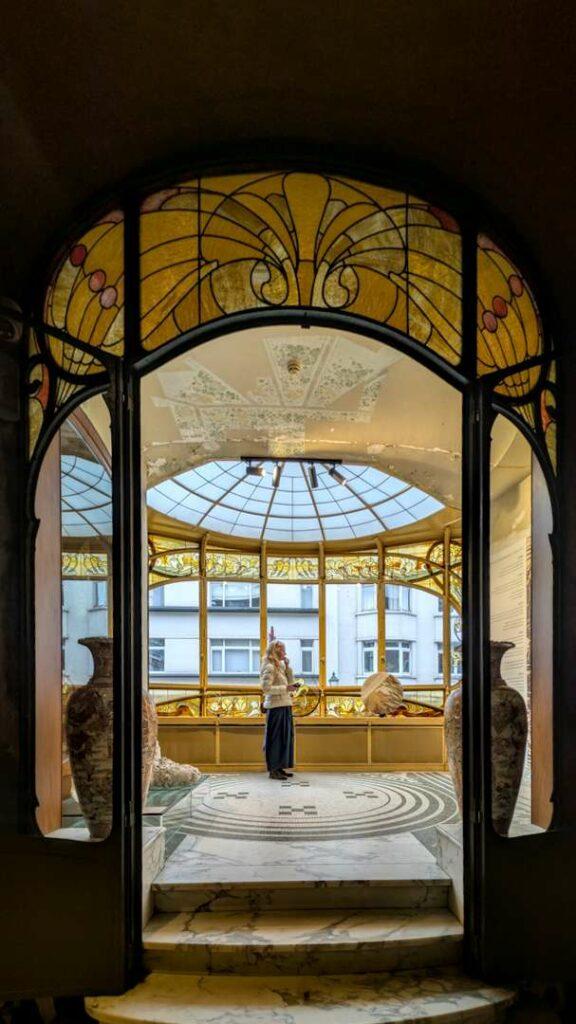
Located in Saint-Gilles, one of the 19 municipalities of the Brussels-Capital Region, the Maison Hannon announces itself before you even cross its threshold. The façade—with its white brick, limestone, and blue stone—curves around the corner like a living thing. But it’s the greenhouse, built entirely of metal and glass, that truly arrests you. It doesn’t simply occupy the corner; it overflows onto the street, audacious and unapologetic, as if the house itself couldn’t be contained.
This was the vision of Jules Brunfaut, an architect who had never worked in the Art Nouveau style before. In 1902, his friends Édouard and Marie Hannon came to him with a commission that would change his life: create a house that synthesized everything they loved—Marie’s passion for botany, Édouard’s devotion to poetry, antiquity, and technology. They had just returned from the 1900 Paris Exhibition, dazzled by the work of Émile Gallé, the master of French Art Nouveau. Now they wanted their own total work of art.
Brunfaut rose to the challenge spectacularly. He studied the houses of Victor Horta, Paul Hankar, and Henry van de Velde. What he created was a fusion—Belgian Art Nouveau meeting French Art Nouveau in a dreamlike, symbolist universe that belonged entirely to the Hannons.
Entering through the garden and basement today (the house opened as a museum in June 2023 after extensive restoration), you climb toward the heart of the house. And then you see it: the central staircase.
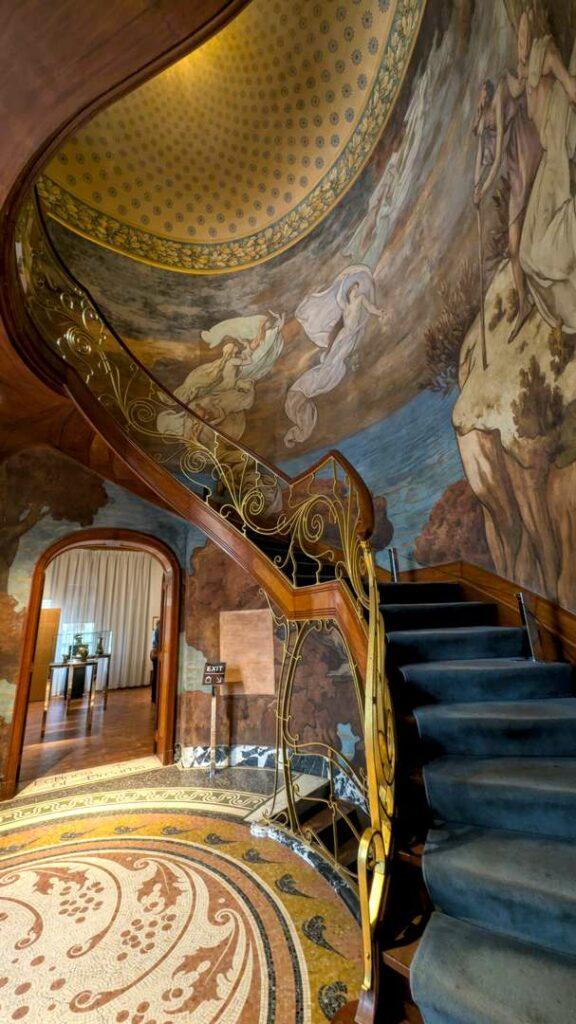
I’ve stood before many grand staircases in my wanderings through Europe’s palaces and museums. But the staircase of the Maison Hannon is different. It doesn’t proclaim power or intimidate with scale. Instead, it invites. Light pours through the immense bow window, illuminating frescoes by Paul Albert Baudouin, mosaics that catch the sun, stained glass that fractures it into jeweled fragments. The bannister curves like a vine, the floor tiles form intricate floral patterns, and everywhere—in every detail—you feel the presence of nature transformed into art.
The house unfolds across three levels, though only a few rooms are fully furnished (many pieces, including Gallé’s original furniture, are gradually returning home). But what remains speaks volumes. Each room was conceived as part of a closed, symbolic universe—a refuge from the industrial world outside, where beauty could reign absolute.
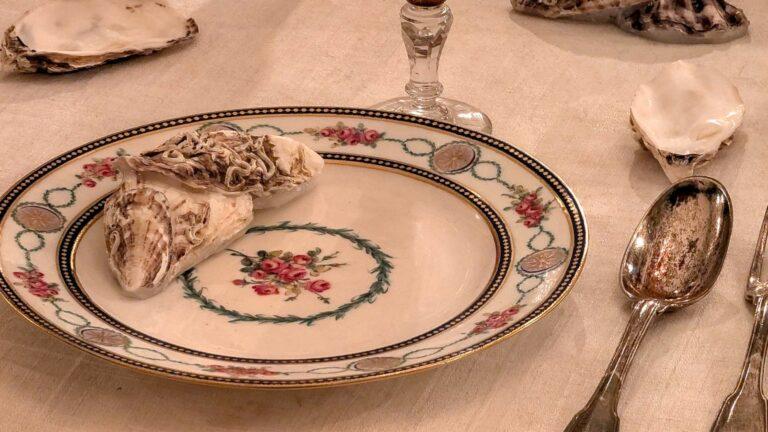
In the smoking room, remnants of frescoes hint at the evenings Édouard might have spent there, discussing philosophy and poetry with friends. The dining room still bears traces of the elaborate dinners the couple hosted, meals served on crystal designed by Gallé himself. And throughout, the motifs repeat: chrysanthemums, poppies, vines, water lilies—nature stylized but never tamed.

What moved me most wasn’t the grandeur, though. It was the intimacy. This was never meant to be a museum. It was a home, built by people who believed passionately in beauty’s power to transform everyday life. When I learned that Édouard Hannon was a photographer and that his work had been preserved here for decades (the house served as a photography center from 1988 to 2014), it made perfect sense. This was a house built by people who paid attention—who noticed light, composition, the way shadows fell across a table.
Standing in those luminous rooms, I thought about what it means to choose beauty so deliberately. The Hannons didn’t simply buy beautiful objects; they commissioned them, collaborated with artists, insisted on harmony between every element. They made beauty their daily companion.
The house has survived against considerable odds. After their daughter’s death in 1965, it was sold, ransacked, left to deteriorate. By the 1970s, it seemed doomed. But the daughter of Jules Brunfaut raised the alarm, the commune of Saint-Gilles acquired it, and slowly, restoration began. Now, after major renovations completed in recent years, it stands again as a testament to what Art Nouveau promised: a more beautiful way of living.
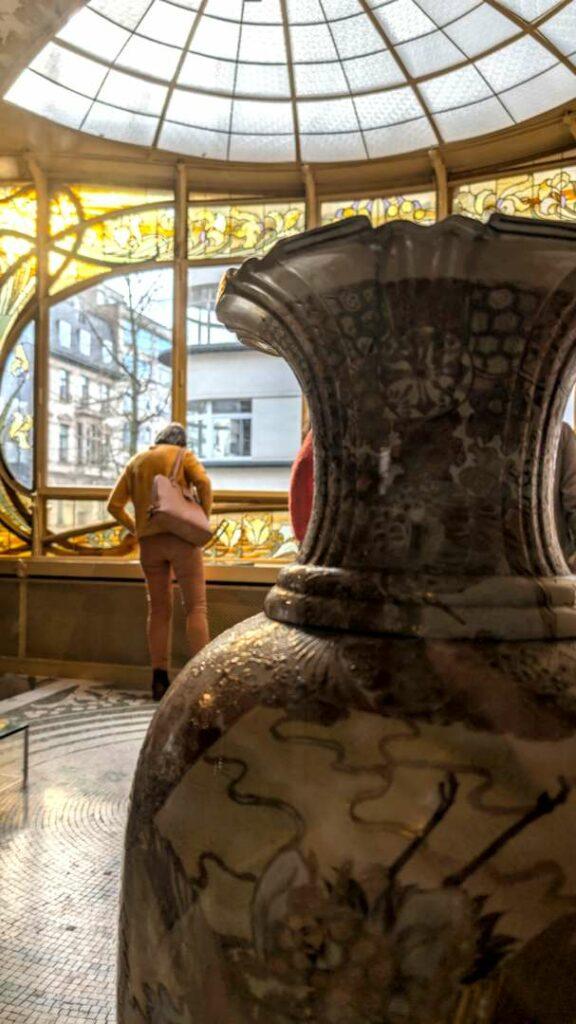
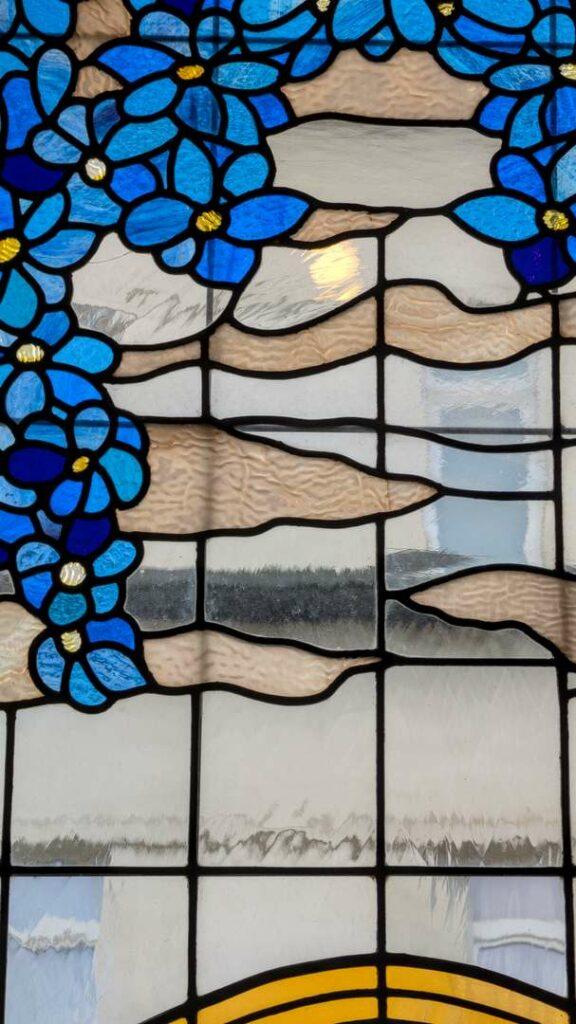
Before leaving, I stood once more before that magnificent greenhouse, watching how the light played across its curves. Brussels earned her title as the capital of Art Nouveau honestly, building by painstaking building. And the Maison Hannon, with its fusion of Belgian practicality and French sensuality, represents something essential about this country I’m coming to love—its genius for synthesis, for bringing together seemingly foreign elements into something entirely new.
As I stepped back into the street, the ordinary world felt subtly transformed, as if the house’s dreamlike logic had followed me out. Perhaps that’s Art Nouveau’s greatest gift: not escape from reality, but a reminder that reality itself can be shaped, curved, made more beautiful if we dare to try.
Until tomorrow, Merry Advent !
Practical Note: The Maison Hannon offers a combined ticket with the Horta Museum—two jewels for one journey through Art Nouveau Brussels. The walk between them takes just ten minutes, and each deserves at least 45 minutes of unhurried attention. Visit Thursday through Sunday, and let yourself wander without haste. This is architecture meant to be savored.

During the 2025 Advent season, each post on The Ritual of Reading was accompanied by a Daily Advent Letter, sent privately to subscribers. These letters echo the theme of the article, but take a more personal and reflective path — closer to the hesitations, intuitions, and emotions that accompanied the writing.
What follows is the Daily Advent Letter that was written alongside this post.
| December 9th |
| Dear Friend, I need to tell you something that feels almost like a confession. I don’t resonate with Art Nouveau. Standing in the Maison Hannon the other day, surrounded by precisely the kind of beauty I should adore—organic curves, botanical motifs, light transformed into poetry through stained glass—I felt it again. That strange distance. Intellectually, I understand its brilliance. Aesthetically, I find it exquisite. But emotionally? I’m not there. It’s the oddest feeling, like standing before a door I cannot open. Or perhaps one I don’t want to. Does this ever happen to you? Where something objectively beautiful leaves you cold, or worse—leaves you with an inexplicable unease you can’t quite name? I’ve tried to understand it. Art Nouveau should be exactly my aesthetic—it’s everything I claim to love. Nature stylized into art. The rejection of harsh industrial lines. Beauty as a daily practice. And yet when I’m surrounded by it, something in me resists. Not actively. Just… quietly steps back. Sometimes I wonder if I lived in that time, in some previous existence, and something happened that I don’t want to remember. I’m not getting mystical on you—or maybe I am, just a little. But I believe we experience the world, and art in particular, on different levels of understanding. There’s the intellectual level, where we can appreciate technique and historical significance. There’s the aesthetic level, where we recognize formal beauty. And then there’s something deeper, something visceral, that either opens to a work of art or doesn’t. And that deepest level? You simply cannot force it. I’ve tried. I’ve read the histories, studied the architects, stood patiently before the most celebrated examples. I’ve wanted to feel what I’m supposed to feel. But wanting isn’t enough. The Maison Hannon is objectively extraordinary—I can see that, I can write about that, and tonight’s video will show you why it matters. But I walked through those dreamlike rooms feeling like a careful translator rather than a native speaker. Understanding the words but missing some essential music beneath them. Perhaps that’s okay. Perhaps we’re not meant to resonate with everything, even things we respect. Perhaps these gaps in our aesthetic map tell us something important about who we are—or who we were, or who we’re becoming. I write about beauty with passion, and yet here I am, admitting that one of Europe’s most celebrated beautiful styles leaves me strangely cold. It feels vulnerable to say this. Like admitting a failure of imagination. But I also think there’s something honest in acknowledging these mysteries within ourselves. The things we cannot force, cannot explain, cannot rationalize into feeling. So I’ll show you the Maison Hannon tonight with all the appreciation I can muster. And maybe one of you will feel what I cannot. Maybe it will open something in you that remains closed in me. I’d love to know if you’ve experienced this too—that peculiar gap between appreciation and resonance. Simply hit reply and tell me. I read every email, and tonight, maybe more than ever, I genuinely want to hear your thoughts. Do you have an artistic style or period that should speak to you but somehow doesn’t? Or one that moves you inexplicably, against all logic? These mysteries feel less lonely when shared. Until tomorrow, Alexandra |

Written by Alexandra Poppy
Writer, reader & curator of The Ritual of Reading
I’m Alexandra, the voice behind The Ritual of Reading. Somewhere between a stack of novels and a half-finished pot of tea, I keep finding traces of the life I want to live—slower, richer, filled with stories. The Ritual of Reading is where I gather what I love: books that linger, places with a past, and rituals that make ordinary days feel a little more meaningful. I write from Paris, where elegant bookshops and old-fashioned cafés offer endless inspiration—and I share it here, hoping it brings a spark to your own days, too.