

There is a particular pleasure in arriving at the end of a journey with the feeling that you have understood something you didn’t quite expect to understand.
When I began this series, I was interested in etiquette as a cultural mirror — a way to see what different societies quietly value, what they protect, what they assume. I started with the Anglo-American tradition because it felt like the natural point of departure: foundational texts, widely translated, the architecture that shaped so much of what we now consider “universal” good manners. Then France, because France is always France — the country that codified courtesy, exported it wholesale and then spent two centuries insisting that it had nothing to do with the aristocracy.
What I hadn’t fully anticipated was how clearly the influence of both those traditions would appear in the three books at the heart of this final chapter. Spain, Italy and Romania share a Latin linguistic heritage, a Mediterranean (or near-Mediterranean) sensibility and a complex relationship with modernity. But each has also absorbed — in its own way, at its own pace, with its own resistance — the codes of courtesy that travelled outward from Paris and London. Reading their etiquette guides is, in part, reading the story of that inheritance. And it is, just as much, reading what they chose to keep that was entirely their own.
Romania: The Etiquette of the Guest and the Power of Inclusion
I should be transparent: Romania is not a country I can approach with the same detachment I brought to Emily Post or William Hanson. I was born there. I grew up there. And growing up, it was simply understood — stated as fact, repeated by teachers and parents alike — that Romanian etiquette was built on the French model. France was the civilisational reference point. Its codes of conduct had been imported so thoroughly that they no longer felt imported at all.
After seventeen years of living in Paris, I can attest to this from the inside. The family resemblance is unmistakable — not because the rules are identical in every detail, but because the underlying logic is the same: courtesy as a form of respect for the other person’s dignity, self-presentation as a social responsibility, the small gesture as something that carries moral weight.
This is not an accident of history. For much of the nineteenth and early twentieth centuries, Bucharest styled itself “the Paris of the East” — not as flattery, but as aspiration. French was the second language of the educated classes. French architecture lined the boulevards. French literature filled the libraries. The influence was so deep that it became invisible, simply absorbed into what it meant to be cultivated in Romania.
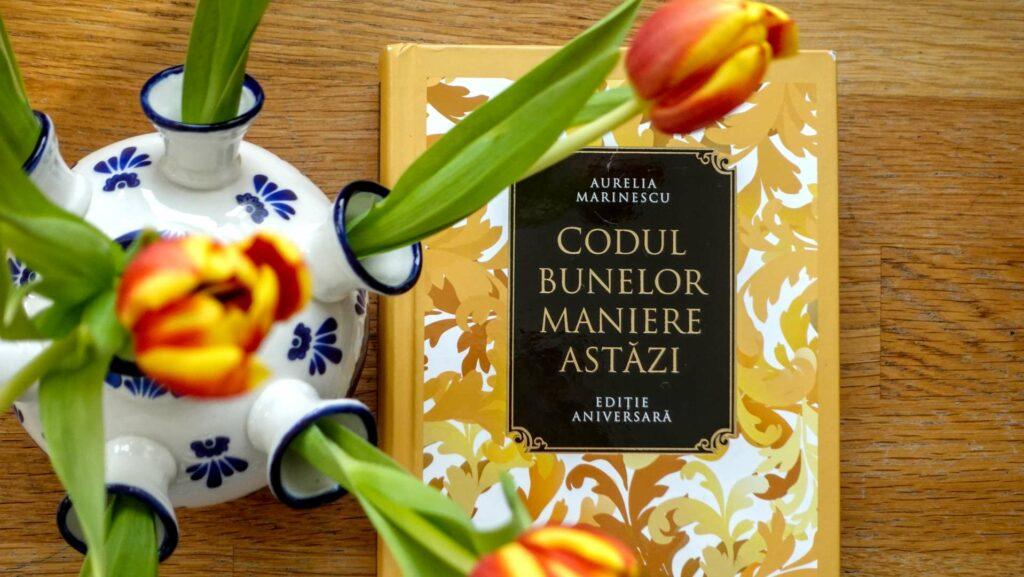
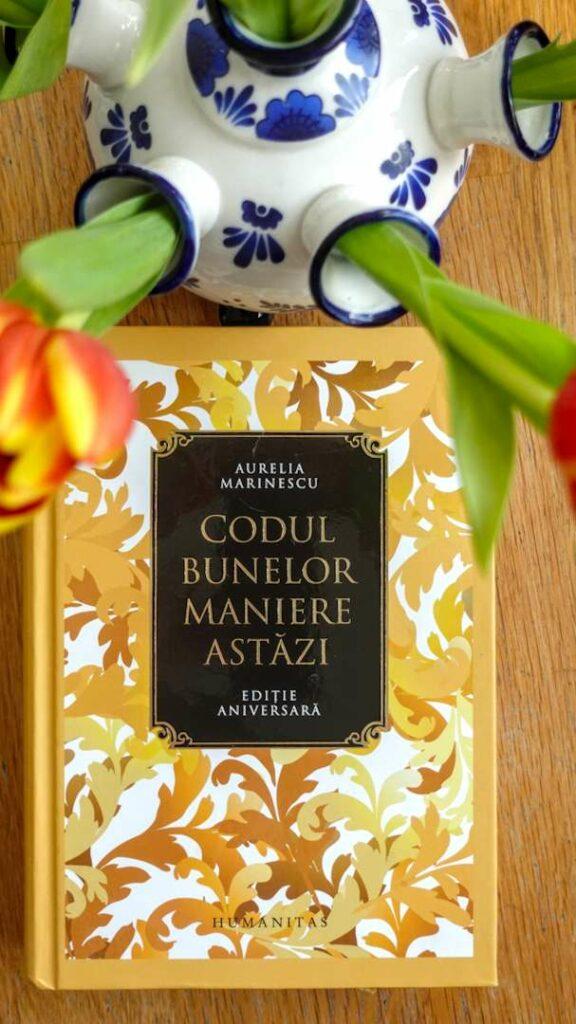
Codul bunelor maniere astăzi by Aurelia Marinescu — The Code of Good Manners Today — reads, in many ways, like a Romanian cousin of the French guides I’d studied. The structure is familiar: greetings, social occasions, correspondence, table manners, professional conduct. The underlying values are recognisable: courtesy as respect for others, self-presentation as a form of social responsibility, the small gestures that hold shared space together.
A Unique Rule: The Ethical Obligation of Language
But there is one chapter that feels unique in my research. One rule that I have never encountered in any British, American, or French guide — and that, upon reflection, reveals something essential about the experience of being Romanian.
Marinescu writes, with quiet firmness, that one should never speak in a foreign language in the presence of people who might not understand it. Not as a general courtesy (though it is that), but as a specific ethical obligation. If even one person in the room does not share the language you are about to use, you switch. You include. You do not conduct a conversation — no matter how convenient, no matter how natural — that leaves someone standing at the edge of comprehension.
I have thought about this rule a great deal. It has no equivalent in the French or English guides, because it doesn’t need one. When you are English or French, you move through the world in a language that others learn in order to speak to you. The question of linguistic exclusion rarely arises in the same way.
But Romania is a small country. It has survived for centuries by being multilingual — learning the languages of the powers that shaped its borders, its economy, its culture. Hungarian, German, French, Russian, English: Romanians have always known that fluency in someone else’s language is not just useful, it is a survival skill. And from that knowledge came a particular sensitivity: if you can speak the language of the room, you are responsible for making the room inclusive.
It is, in its quiet way, one of the most democratic etiquette rules I have encountered. And one I find deeply moving to rediscover in a book from the country where I first learned that good manners meant paying attention to the person next to you.
Italy: Bella Figura and the Art of Living Refined
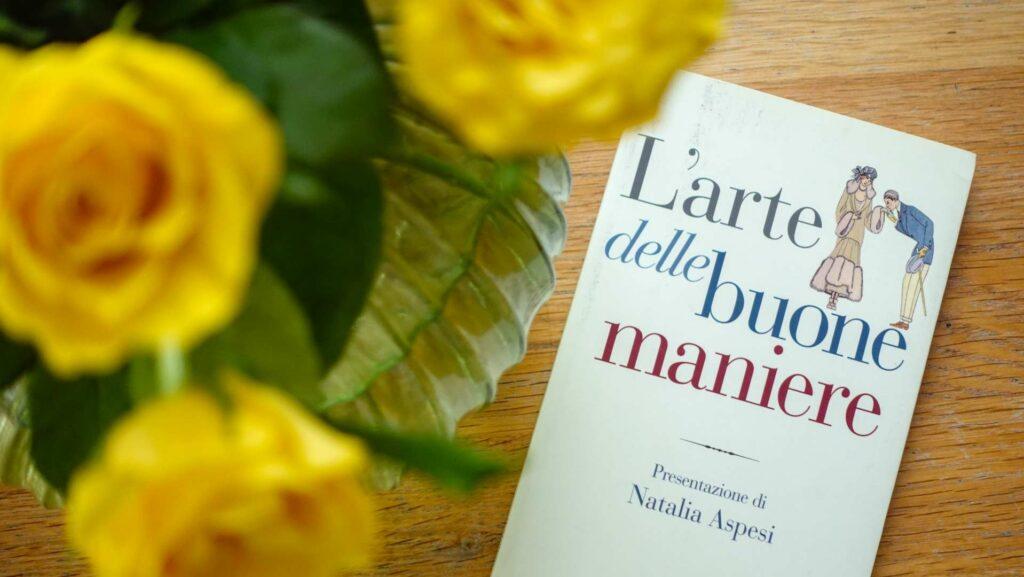
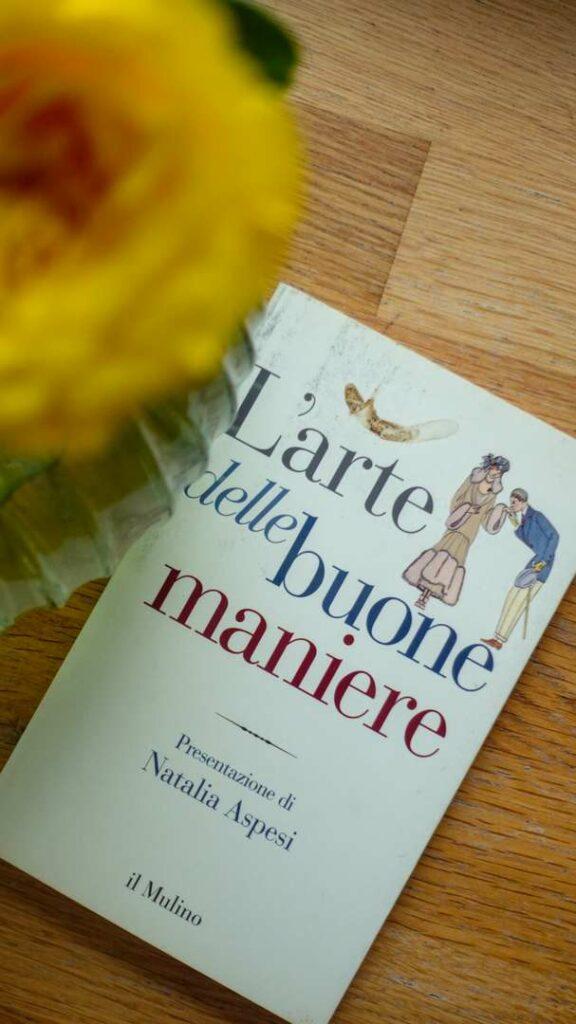
If Romania’s guide carries the emotional weight of a country that has always had to negotiate its place in the world, Italy’s L’arte delle buone maniere — published by Il Mulino — offers something quite different: the confidence of a civilisation that invented the concept of bella figura and has been refining it ever since.
Il Mulino is Italy’s most prestigious academic publisher, which says something about the cultural seriousness with which Italians approach the question of manners, even today. The guide is, of the three in this chapter, the most concise — and yet it manages to be thoroughly comprehensive. Every essential domain of social conduct is covered, but without the sprawling footnotes or extended justifications of some of its counterparts. There is an elegance to this restraint. It feels appropriate.
What strikes me reading it as someone who has travelled extensively through Italy — as a tourist, always as a tourist, which means perpetually grateful and perpetually aware of my own outsider status — is how the guide reflects a country where aesthetic and ethical sensibilities are genuinely intertwined. Bella figura is often translated as “making a good impression,” but this flattens something more interesting. It is closer to the idea that how you present yourself — in dress, in manner, in the care you bring to your interactions — is a form of respect, both for those around you and for yourself. It is Emily Post’s architecture and Eleanor Roosevelt’s character formation, compressed into a single, untranslatable phrase.
Beyond Appearance: The Intersection of Aesthetics and Ethics
The guide takes for granted a certain Italian truth: that the details matter. The way you enter a room. The way you address a stranger versus an acquaintance. The relationship between hospitality and the pleasure of being hosted. Italy is a country where food is not merely sustenance but ceremony, where a Sunday lunch can last four hours and this is not considered excessive but generous. The table, here, is not a stage for hierarchy — as it was in the French tradition — but a stage for connection.
For a reader coming to this book after Post and Roosevelt and Gandouin, what lingers is not any single rule but a general atmosphere: courtesy as an expression of gusto, of genuine pleasure in doing things well. You greet someone properly not because protocol demands it, but because a careless greeting feels, to an Italian, like a small ugliness. And ugliness, in a country that has spent millennia making beautiful things, is simply unnecessary.
Continue Your Italian Journey
Ready to bring the Mediterranean spirit into your own home? Discover my curated guide on living La Dolce Vita through the power of three transformative books.
Explore the Italian Lifestyle Guide →
Spain: Protocolo Pop and the Quiet Revolution of “Tú”
And then there is Spain. And the book that surprised me most in the entire series.
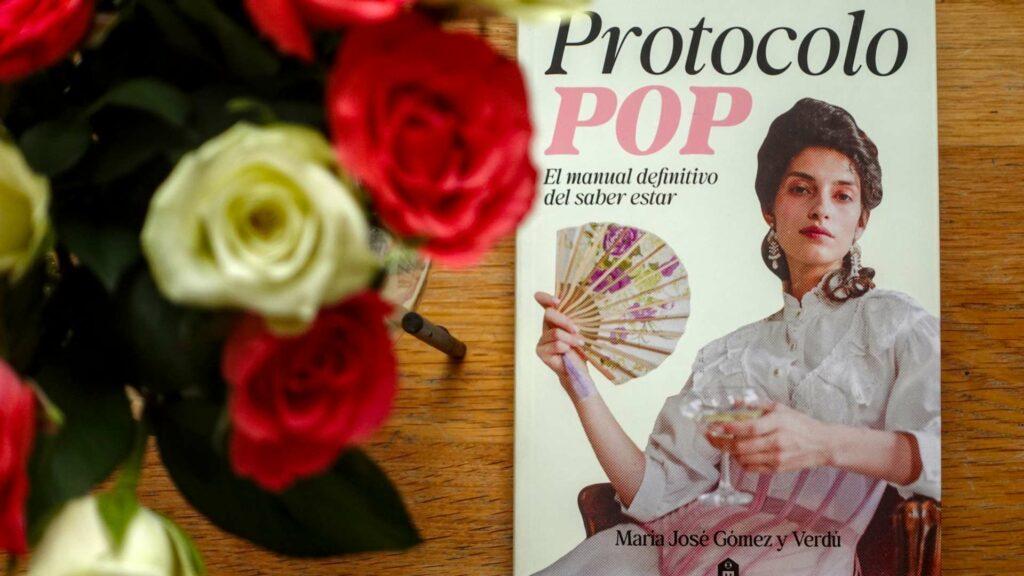
Protocolo Pop by María José Gómez y Verdú is, on the surface, a contemporary etiquette guide — witty, accessible, attentive to the social media age. Gómez y Verdú is Spain’s best-known etiquette authority, with a substantial Instagram following and a media presence that would feel familiar to anyone who has watched William Hanson’s own rise to digital-age relevance.
But there is something in Protocolo Pop that none of the other books in this series do, something that functions almost as a manifesto embedded inside a manual: she addresses the reader as tú.
This sounds like a small thing. It is not.
In Spanish, as in French, the choice between the formal usted and the familiar tú is not merely grammatical — it is social positioning. It encodes the relationship between the person speaking and the person being addressed. Etiquette guides, by their very nature, position the author as the authority and the reader as the learner. Every other guide I read for this series — French, Romanian, British, American — adopts a formal or neutral register. They instruct. They advise. They maintain a professional distance.
Gómez y Verdú says tú. She treats the reader as a peer. And in doing so, she enacts the very philosophy her book advocates: that courtesy is not a hierarchy, but a shared language between equals.
Breaking Hierarchy: Why the Familiar Pronoun Matters
What makes this even more interesting is that this is not simply a personal stylistic choice. It reflects a broader, ongoing shift in contemporary Spanish — a quiet reform of the language that is increasingly replacing usted with tú in everyday contexts, not out of disrespect, but out of a cultural preference for horizontal rather than vertical relationships. It is worth noting that this shift is particular to Spain; in Latin America, usted retains much more of its everyday currency. Gómez y Verdú is writing squarely within the Spanish present, and that present has decided, gradually but unmistakably, that you can be respectful and familiar at the same time.
This, too, is a form of etiquette evolution. Hanson dismantled the elitism of the word “etiquette.” Roosevelt rebuilt courtesy from the inside out. Gómez y Verdú performs, in a single pronoun, the argument that the whole series has been building toward: that good manners are not about distance. They are about genuine recognition. And genuine recognition does not require formality — it requires attention.

The Ritual of Reading: A Manifesto for Modern Courtesy
I have spent this month with nine books on manners — British, American, French, Romanian, Italian, Spanish — and a question that I thought I knew the answer to before I began.
I thought I was going to confirm a belief I already held: that good manners matter, that we have lost something in discarding them, that there is a case to be made for their return. And in a sense, that is what happened. But the argument I found was different from the one I expected to make.
I expected to find rules. I found philosophies.
I expected to find etiquette as performance — the external choreography of social life, the correct fork, the proper greeting. And those are there, in all nine books, in varying degrees of specificity. But underneath every set of rules, in every cultural tradition, runs something more fundamental: the belief that how we behave toward others is an expression of who we are. That the small gestures — the greeting, the attentiveness, the willingness to switch languages so that everyone in the room can participate — are not decorative additions to a life, but its very texture.
“How we behave toward others
is an expression of who we are.”
What has struck me most, across all these traditions, is how differently they arrive at the same place. Post builds from the outside in: master the forms, and you will have created the conditions for genuine courtesy. Roosevelt builds from the inside out: do the inner work, and courtesy will follow naturally. Gandouin anchors courtesy in citizenship — you treat others with respect because they are your fellow citizens, not your inferiors or your superiors. Marinescu insists on inclusion as a form of dignity. Gómez y Verdú insists on equality. And all of them — all nine books — return, sooner or later, to the same quietly radical idea: we share this world, and the way we move through it together is a choice we make, constantly, in small acts that add up to something larger than themselves.
We are living through a moment in which this choice feels harder than it used to. Not because people are fundamentally less considerate than they were — I don’t believe that and I don’t think the evidence supports it. But because the structures that used to transmit these values have weakened, and because we have spent several decades confusing formality with etiquette and then discarding both.
Formality can be exclusive, stifling, a mechanism for maintaining hierarchies that serve only those already at the top. We were right to challenge it. But courtesy is not formality. Courtesy is the acknowledgement that the person in front of you — the waiter, the stranger on the metro, the colleague in the meeting, the shopkeeper you see every Tuesday — is a full human being, deserving of your attention and consideration. It costs nothing. It requires only the decision to notice.
The books I have read this month are not, in the end, about cutlery rules or how to address an envelope. They are about the ritual of paying attention. Of choosing, daily, to be the kind of person it is a pleasure to encounter. Of understanding that your freedom to occupy space — loudly, carelessly, as if the world were a stage set for your convenience — ends where another person’s begins.
This is not a return to a golden age that never existed. Every tradition I’ve explored this month had its blind spots — its exclusions, its assumptions, its blind deference to hierarchies that deserved to be questioned. We are not trying to resurrect Edwardian England or the French Second Empire. We are trying to keep what was worth keeping: the understanding that shared life requires shared responsibility.
And here is what I have come to believe, after all these weeks of reading: etiquette, at its best, is not a constraint on freedom. It is one of its foundations. The freedom to move through the world without fear of humiliation. The freedom to share a table, a carriage, a street, without bracing yourself against the carelessness of others. The freedom that comes from knowing that the rules exist not to exclude, but to include — not to enforce hierarchy, but to acknowledge, quietly and consistently, our common humanity.
Codul bunelor maniere astazi. The code of good manners today. Not yesterday’s. Not a museum piece. Today’s.
Because we still share this world. And the way we treat each other in it still matters.
I hope it always will.
The Reading List for Part IV
For the Voice of a Small Country That Learned to Listen: Codul bunelor maniere astazi by Aurelia Marinescu – 🇷🇴
For the Italian Art of Living Well: L’arte delle buone maniere – Il Mulino – 🇮🇹
For the Contemporary Spanish Revolution: Protocolo Pop by María José Gómez y Verdú – 🇪🇸
Note: This is Part IV — the final chapter — of my series “The Art of Good Manners.” Read Part I: In Defense of Good Manners Read Part II: On English and American Etiquette Read Part III: French Savoir-Vivre

Written by Alexandra Poppy
Writer, reader & curator of The Ritual of Reading
I’m Alexandra, the voice behind The Ritual of Reading. Somewhere between a stack of novels and a half-finished pot of tea, I keep finding traces of the life I want to live—slower, richer, filled with stories. The Ritual of Reading is where I gather what I love: books that linger, places with a past, and rituals that make ordinary days feel a little more meaningful. I write from Paris, where elegant bookshops and old-fashioned cafés offer endless inspiration—and I share it here, hoping it brings a spark to your own days, too.
Enter The Ritual of Reading
Each Sunday, receive a letter to steady your attention—literary inspiration, seasonal rituals and reflections from a life shaped by books.
On the first of each month, a gift: The Literary View, a custom wallpaper created to accompany your days.
It’s fascinating to see how these cultures still hold such a strong emphasis on polite behavior. I’ve always found the Italian concept of *fare la bella figura* particularly intriguing.