Austrian Advent Calendar Day 12

Hello, dear friends, and welcome to the twelfth day of our Advent Calendar.
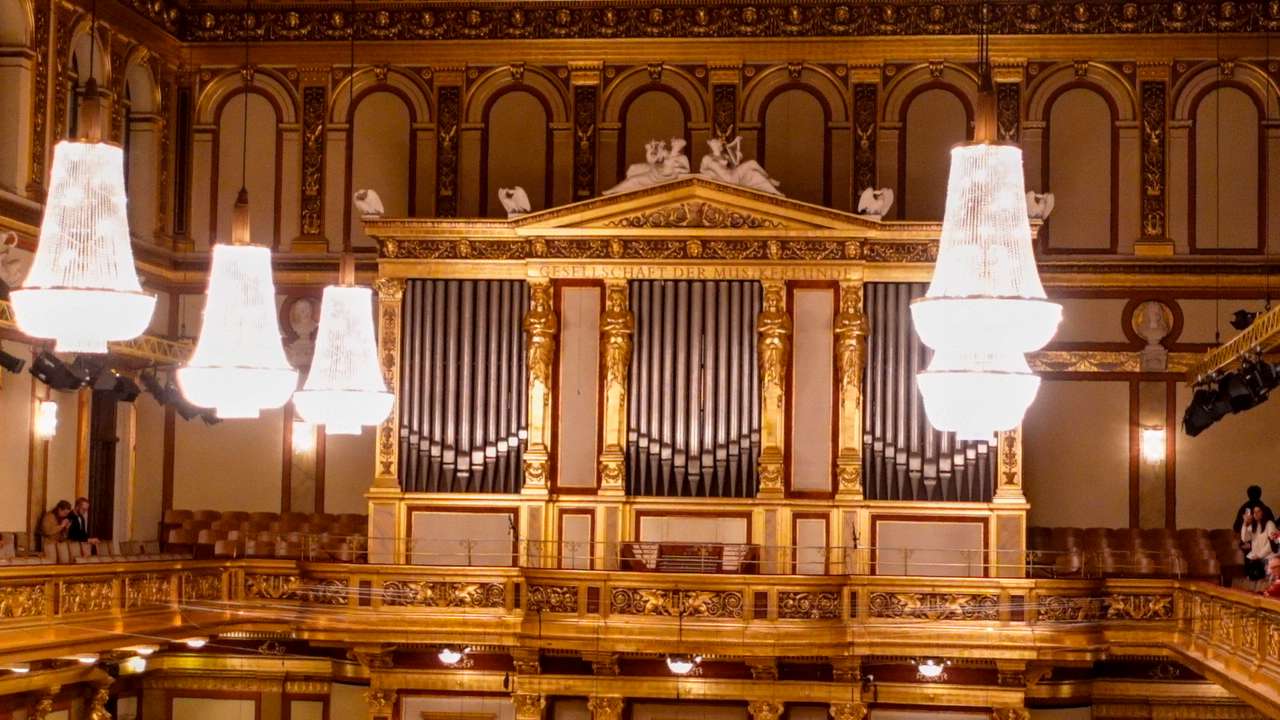
Today I’m sharing with you a dream fulfilled: welcome to the Vienna Musikverein concert hall!
Classical music enthusiasts will recognize this world-famous venue immediately, thanks to a historic annual event broadcast to millions: the New Year’s Concert. The Wiener Musikverein—Viennese Music Association—was inaugurated in 1870 and serves as the home of the Vienna Philharmonic Orchestra. Constructed on land donated by Emperor Franz Joseph according to plans by Danish architect Theophil Hansen, the Musikverein houses several performance spaces, the most celebrated being the Great Hall, also called the Golden Hall for reasons that become immediately apparent when you step inside.
This hall is said to possess one of the finest acoustics in the world, standing alongside Berlin’s Konzerthaus, Amsterdam’s Concertgebouw, and Boston’s Symphony Hall in that rarified company of spaces where music sounds exactly as it should—clear, balanced, enveloping, alive.
Like many concert halls constructed in the nineteenth century, the Great Hall follows a long, tall, narrow shoebox shape. What makes its acoustic perfection particularly remarkable is that it was based entirely on the architect’s instinct and experience rather than scientific analysis—no formal acoustical studies existed at the time. Hansen relied on proportion, materials, and perhaps some architectural intuition bordering on magic. That his design achieved such flawless results makes the achievement all the more extraordinary.


The most famous event taking place at the Musikverein each year is the New Year’s Concert, a tradition begun in 1939. The musicians of the Vienna Philharmonic Orchestra vote to select each year’s conductor—a deeply democratic practice for such an elite institution. Together they prepare a program consisting primarily of pieces by the Strauss family—Johann Strauss II especially, the “Waltz King” whose music has become synonymous with Viennese elegance—but also works by other composers who capture the spirit of celebration and renewal.
The concert has three performances: December 30th, December 31st, and the most important on January 1st at 11:15 in the morning. This is the performance broadcast live throughout Europe and transmitted to countries across the globe. It commands one of the largest television audiences in the world, surpassed only by major international sporting events. The Austrian broadcast includes an additional gift: images from the countryside carefully matched to the music, and one or two previously recorded ballet sequences performed by the Vienna State Ballet in historic settings, wearing specially designed costumes.

The New Year’s Concert is fundamentally a celebration of life itself. You marvel at the elaborate flower arrangements transforming the Golden Hall into a garden. You analyze the costume designs for the ballet interludes (I will never forget Vivienne Westwood’s 2014 creations—sculptural, playful, utterly distinctive). You watch for the particular sparkle of originality in each conductor’s interpretation, the small choices that make this year’s performance different from all the others. It represents a beginning to the year that foregrounds everything harmonious and joyful, carried on the irresistible melodies of Johann Strauss’s music—waltzes and polkas that make even sitting still feel like dancing.
So why am I telling you all of this? Because I grew up in a household that watched the Vienna New Year’s Concert with something approaching religious devotion, at least from the early 1990s when Romanian television began broadcasting it following the Revolution. I didn’t always understand its beauty, especially as a child—the long stretches of orchestral music tested my patience, and I couldn’t grasp why my parents seemed so transported. But I was always fascinated by the joy it brought them, the way they would sit together utterly absorbed, sometimes humming along, my mother occasionally rising to waltz a few steps around the living room.
With time, the flame passed to me. I began to understand what they were hearing, what they were feeling. The music became mine as well.

Attending the New Year’s Concert itself is nearly impossible—tickets are allocated through a complex lottery system and command astronomical prices on the secondary market. But being in the Golden Hall of the Musikverein on any occasion is a day you remember for the rest of your life. For me—or rather, for us, since I would never experience this without my parents beside me—it was on a Saturday evening in December, listening to Mozart and Vivaldi, pinching ourselves in disbelief that we were actually here, in this space we’d watched on television for decades, surrounded by that legendary golden light and impossible beauty.
The acoustics were everything promised and more. The music didn’t come from the stage—it seemed to exist all around us, filling the air like something tangible you could almost touch. My mother cried. My father kept looking around with wonder, like a child seeing something magical for the first time.
Dreams do come true, sometimes in the most literal and perfect way imaginable.
Until tomorrow, dear friends—write down your dream and send it to Santa Claus. You truly never know what might be possible.
VIENNA MUSIKVEREIN:
The Golden Hall (Großer Saal):
- Capacity: 1,744 seats (standing room: 300)
- Opened: January 6, 1870
- Architect: Theophil Hansen
- Known for: Exceptional acoustics, gilded decoration, caryatid sculptures
- Home to: Vienna Philharmonic Orchestra
New Year’s Concert (Neujahrskonzert):
- Started: 1939
- Three performances: Dec 30, Dec 31, Jan 1 (most important)
- Broadcast to over 90 countries
- TV audience: estimated 50+ million worldwide
- Conductor: Elected annually by orchestra members
- Program: Primarily Strauss family, some other composers
- Ticket lottery opens in January for following year’s concert
Visiting the Musikverein:
- Concert tickets: Book well in advance through official website
- Guided tours: Available in multiple languages when no rehearsals scheduled
- Dress code: Smart casual to formal, depending on performance
- Standing room: Limited cheap tickets available day-of-performance for some concerts
Other Notable Venues in Vienna:
- Vienna State Opera (Wiener Staatsoper)
- Konzerthaus Wien
- Theater an der Wien
MUSICAL RECOMMENDATIONS:
If you want to experience the spirit of the New Year’s Concert:
- Johann Strauss II: The Blue Danube Waltz, Radetzky March (traditional finale)
- Josef Strauss: Delirien Waltz
- Johann Strauss I: Radetzky March
- Watch past New Year’s Concerts on YouTube or streaming services

Written by Alexandra Poppy
Writer, reader & curator of The Ritual of Reading
I’m Alexandra, the voice behind The Ritual of Reading. Somewhere between a stack of novels and a half-finished pot of tea, I keep finding traces of the life I want to live—slower, richer, filled with stories. The Ritual of Reading is where I gather what I love: books that linger, places with a past, and rituals that make ordinary days feel a little more meaningful. I write from Paris, where elegant bookshops and old-fashioned cafés offer endless inspiration—and I share it here, hoping it brings a spark to your own days, too.