
Belgian Advent Calendar – Day 3
I grew up in Europe’s Eastern-continental climate in the late twentieth century, which meant winters that were unmistakably, uncompromisingly snowy. For me, the spirit of the holidays has always lived in those white-washed days: rooftops brushed with powder, entire hills fading into a soft blur of white, the muffled stillness that only snow can create. So for my Belgian Advent preparations, I wanted to find the winters of long ago—the winters that shaped imaginations before our own. And in Belgium, I’m in luck: the great Flemish painters have preserved these winters like pressed flowers, perfectly intact, waiting for us.
So I made my way to the Royal Museum of Fine Arts of Belgium, right across from the Royal Palace—the grand, beating heart of Brussels’ art history.
The Old Masters collection is the natural doorway if you ever feel the need to reconnect with the basics. It holds luminous Dutch interiors, elegant Italian altarpieces, a handful of memorable French canvases, and the names that anchor entire chapters of European art: Rembrandt, Van Dyck, Rubens, and of course the Brueghels, Pieter—father and son.
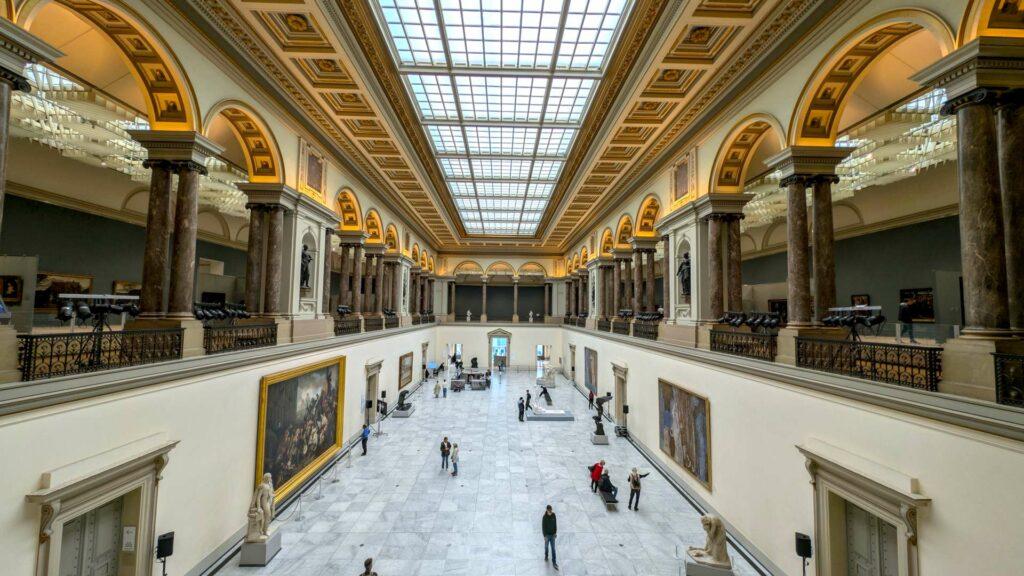
For this visit, I chose a vantage point I often return to in museums: a themed treasure hunt. This time—winter landscapes. Museums can be overwhelming in their scale and variety, and halfway through a visit, everything begins to blur. But with a sharp theme in mind, the artworks seem to call out to you. By the end, you see your quarry with startling precision.
Here are the treasures that revealed themselves to me as I wandered through centuries of beauty, looking for the winters of Belgium’s past.
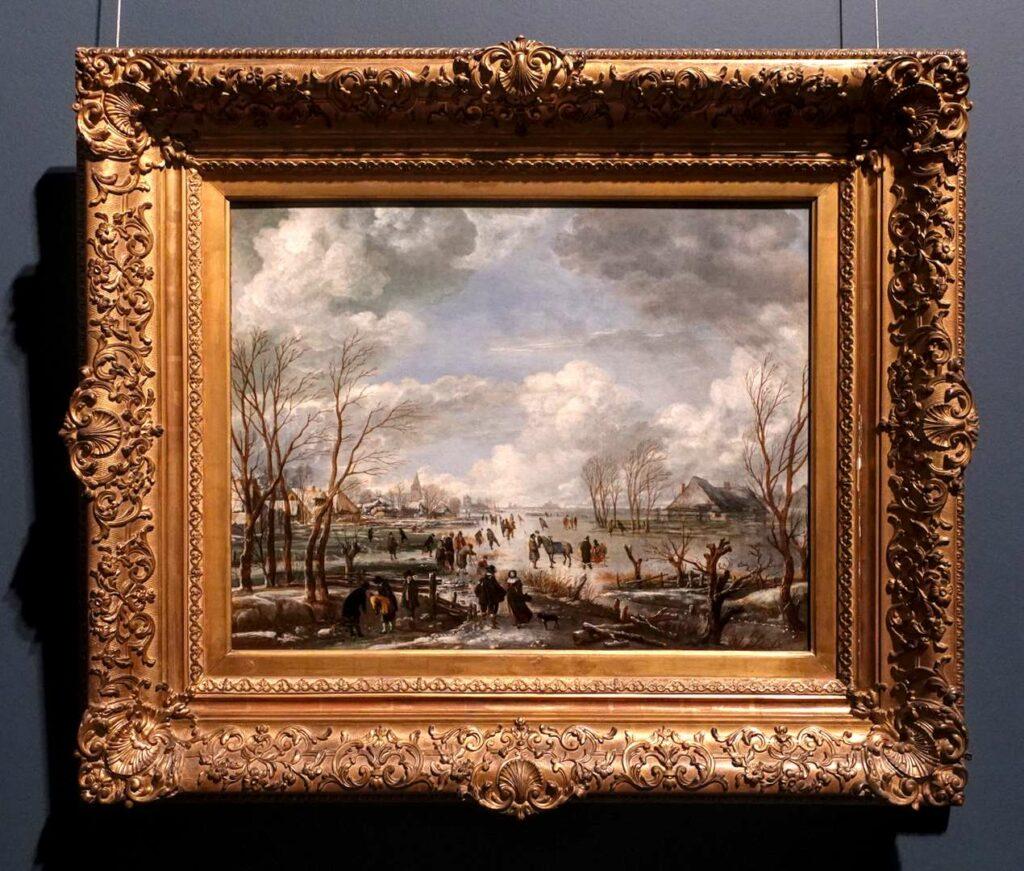
Aert van der Neer – The Pleasures of Winter, 17th century
Van der Neer painted winter as if it were made of silver light—quiet, crystalline, and full of human warmth. His winter scenes often show villagers skating or gathering on frozen waterways, tiny figures glowing against the dusk. He was one of the Dutch Golden Age’s great chroniclers of night and winter; so much so that these scenes became his signature. Standing before this canvas, I felt the hush of a frozen river and the soft bustle of people finding joy in the cold.
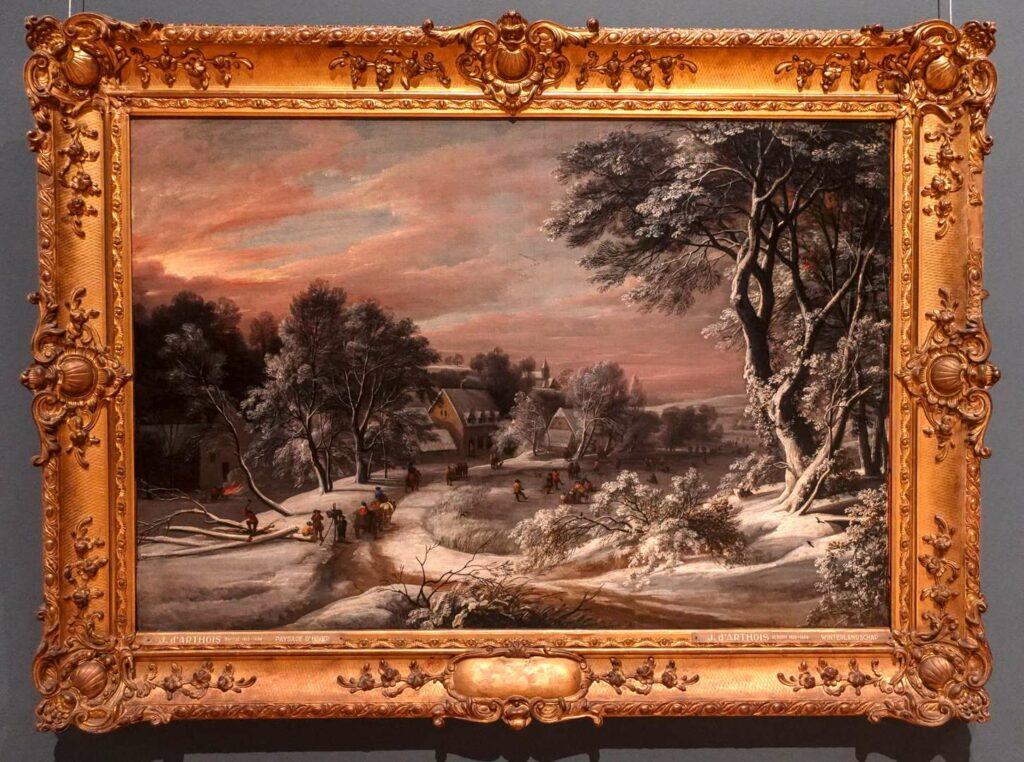
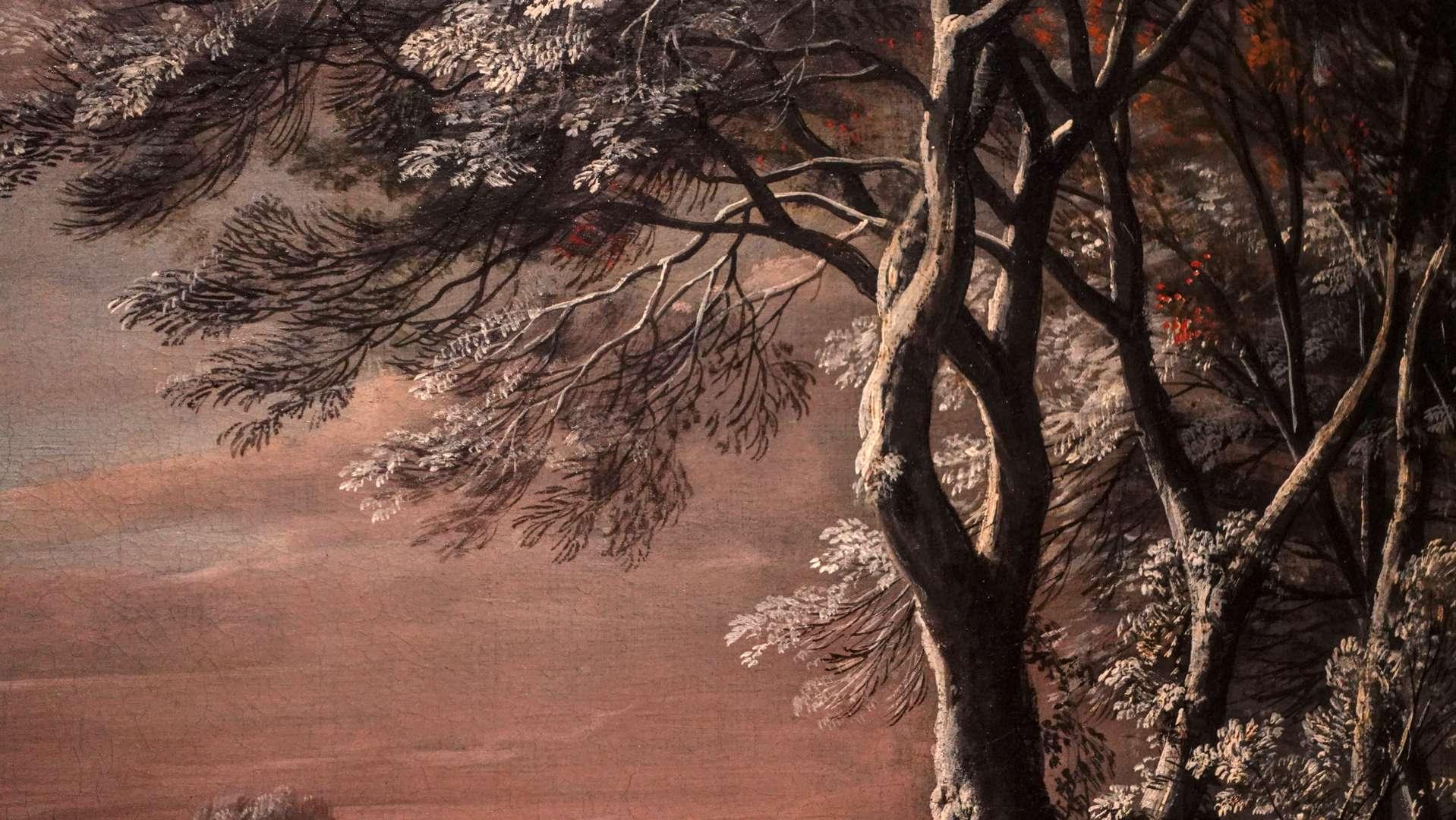
Jacques d’Arthois – Winter Landscape, 17th century
A Brussels native, d’Arthois belonged to the famous “Brussels Landscape School,” known for its richly wooded scenes. Even in winter, his compositions overflow with dense trees and winding paths, as if inviting the viewer to step in and explore. His winter is less about human activity and more about the quiet endurance of nature—a forest holding its breath under a thin veil of frost.
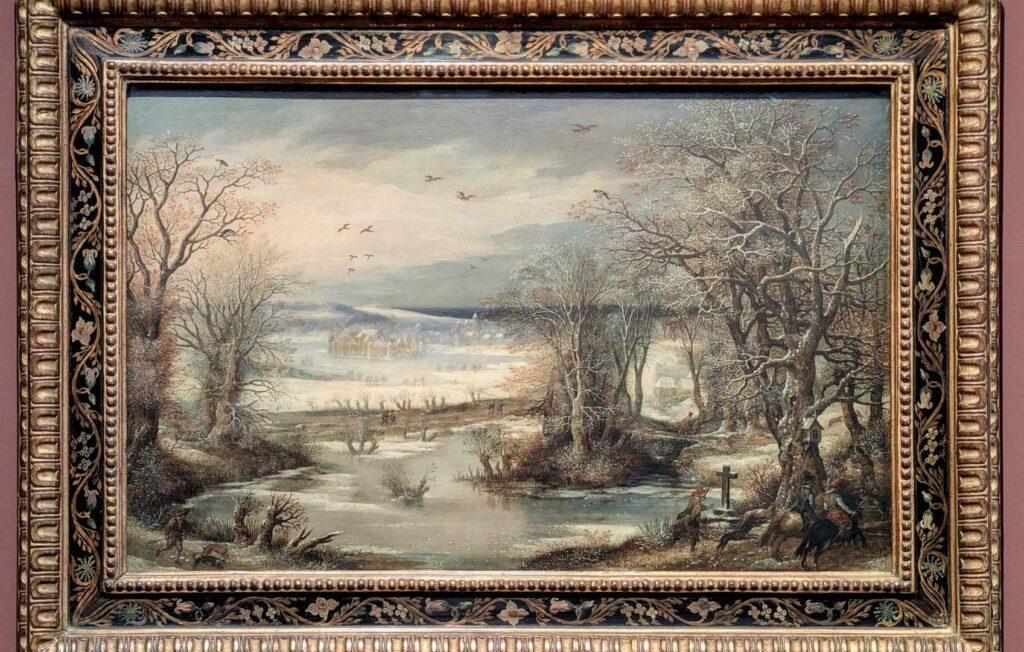
Denijs van Alsloot – Winter Landscape with a View over Tervuren Castle, 1614
Van Alsloot was the court painter to Archduke Albert and Archduchess Isabella, which meant he captured the landscapes around Brussels with extraordinary detail and care. This particular painting unravels like a winter fairy tale: frozen ponds and a delicate hush floating over the land around Tervuren Castle, villagers on foot and two lords riding in what appears to be a pheasant hunt—a typical winter scene. This canvas enchanted me instantly, the frozen moment in time feeling like a memory from a past life. It has become the mascot of this year’s Advent Calendar, the visual companion to my December wanderings.
And of course, no winter pilgrimage through Flemish art is complete without the Brueghels.
In both Pieter Brueghel the Elder’s and Pieter Brueghel the Younger’s versions of The Census at Bethlehem, as well as the Younger’s Massacre of the Innocents, the biblical story unfolds in a recognisably Flemish village—snowy roofs, bustling villagers, children playing, tradespeople pushing carts through the slush. The sacred narrative is transported into the everyday reality of 16th- and 17th-century life, giving us not only a story, but a slice of winter as Brueghel himself saw it.
Yet the painting that stole my heart is a quiet masterpiece:
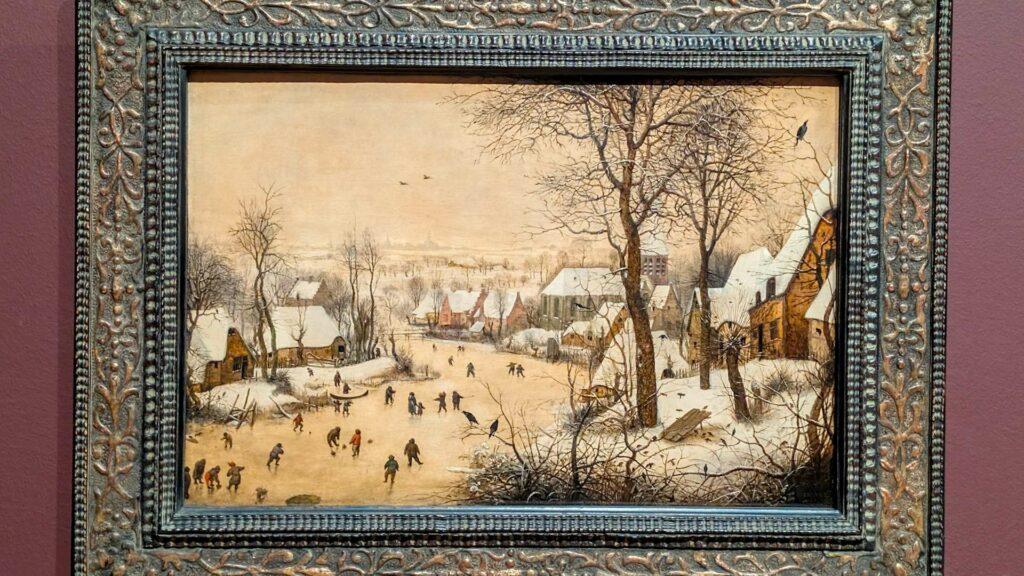
Pieter Brueghel the Elder – Winter Landscape with a Bird Trap (1565)
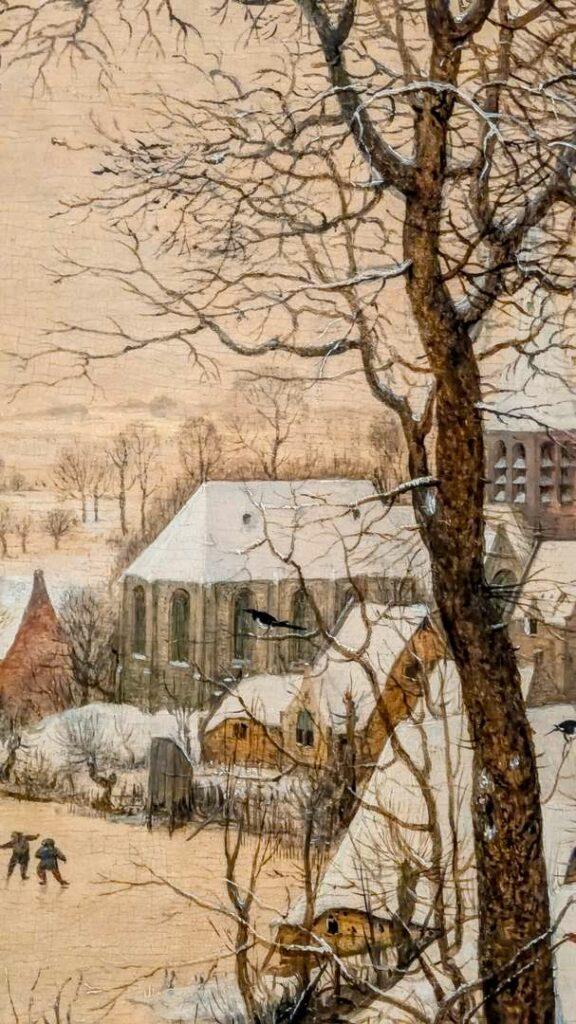
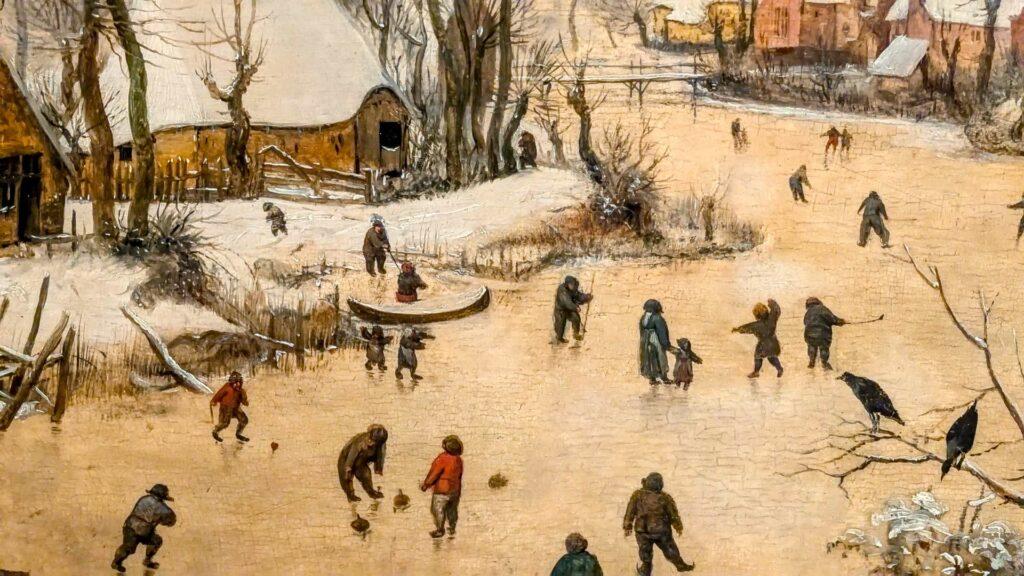
At first glance, it seems simple—almost modest in size compared to the grand canvases nearby. A frozen river. Children skimming across the ice. A village tucked beneath the snow. Bare trees stretching like delicate calligraphy against the sky.
But look longer, and the world reveals itself. The Brueghel family’s winter landscapes belong to a transformative moment in European art: for the first time, landscape itself—not a saint, not a myth—became the subject. Painted during the famously harsh winter of 1564–65, the scene is part of a series chronicling the months of the year, though this particular panel carries a softness that sets it apart.
Why this one, above all others?
Because when I look at it, I recognise my childhood. More than four centuries divide his winter from mine, and yet the spirit is unchanged: that same worry-free joy of a snow day on the lake, of nothing more pressing or more important to do than celebrate being alive in the dead of winter. When everything is frozen yet the blood runs warm, flushing the cheeks of joyous children, and offering parents a reminder of the beauty that lies beneath the hardship of winter. This painting is calm and joyful at the same time; it’s the cosiness of warm fireplaces you can imagine inside each home, and the exuberance of winter games outdoors. The bird trap adds its own quiet truth: sometimes the birds get away with their feast; sometimes humans claim their meal. Life is always a negotiation between the two.
Brueghel’s winter is transfigured by this unassuming panel—as if he distilled the entire season into a single breath, a single stillness that continues to glow centuries later.
My visit to the Royal Museum of Fine Arts felt like stepping into a winter wonderland, crowned by the discovery of a painting that instantly became part of my inner landscape. And with it, I learned something about my own evolving taste—what I look for, what I return to, what still moves me.
Until tomorrow, Merry Advent !
P.S. The snowy landscapes of Belgium that unfold in these paintings are the very world Zeno walks through in The Abyss by Marguerite Yourcenar — the same winter light, the same silences, where Flemish soil and inner exile meet.

During the 2025 Advent season, each post on The Ritual of Reading was accompanied by a Daily Advent Letter, sent privately to subscribers. These letters echo the theme of the article, but take a more personal and reflective path — closer to the hesitations, intuitions, and emotions that accompanied the writing.
What follows is the Daily Advent Letter that was written alongside this post.
| December 3rd |
| Dear Friend, I used to think I knew exactly what kind of art person I was. The kind who walked past the Old Masters with polite respect but no real spark. The kind who quickened her pace for the Impressionists, maybe, but really came alive in front of lively abstracts—those unexpected colours, that frenzy of shape, the thrill of something completely new. I had drawn a boundary in my mind, and on one side stood me, and on the other stood centuries of careful realism that felt, if I’m honest, a little… distant. A little dutiful. It wasn’t that I disliked the Old Masters. I just didn’t think they were for me. But something shifted over the past few years—not a sudden conversion, but a quiet loosening. I realized I didn’t actually know what I was walking past. I knew names, dates, the broad strokes of art history. But I didn’t know the why behind a composition, the context that made a particular canvas revolutionary, the schools and rivalries and technical breakthroughs that shaped what I was seeing. So I stopped asking myself to feel something I didn’t feel. Instead, I decided to learn. Knowledge before appreciation. Understanding before emotion. And then—standing in front of Brueghel’s Winter Landscape with a Bird Trap—something unexpected happened. I wasn’t thinking about brushwork or historical context or the Flemish school. I was just… there. In that frozen village. On that river. Recognizing my own childhood in a painting made four and a half centuries before I was born. It turns out you don’t have to be two different people to love both Brueghel and Mondrian. Art matches our inner world, and we’re never just one feeling at once. The same person who craves geometric clarity can also crave the hush of snow falling on a 16th-century village. The same heart that wants innovation can also want homecoming. I’ve discovered something completely unexpected about myself this December: that Brueghel the Elder’s winter speaks to me in a way no other landscape does. That I can experience the Old Masters with my soul, not just my mind. That I’m allowed to change—even to surprise myself. I thought I knew what moved me. Turns out, I’m still learning. Until tomorrow, Alexandra |

Written by Alexandra Poppy
Writer, reader & curator of The Ritual of Reading
I’m Alexandra, the voice behind The Ritual of Reading. Somewhere between a stack of novels and a half-finished pot of tea, I keep finding traces of the life I want to live—slower, richer, filled with stories. The Ritual of Reading is where I gather what I love: books that linger, places with a past, and rituals that make ordinary days feel a little more meaningful. I write from Paris, where elegant bookshops and old-fashioned cafés offer endless inspiration—and I share it here, hoping it brings a spark to your own days, too.
Enter The Ritual of Reading
Each Sunday, receive a letter to steady your attention—literary inspiration, seasonal rituals and reflections from a life shaped by books.
On the first of each month, a gift: The Literary View, a custom wallpaper created to accompany your days.