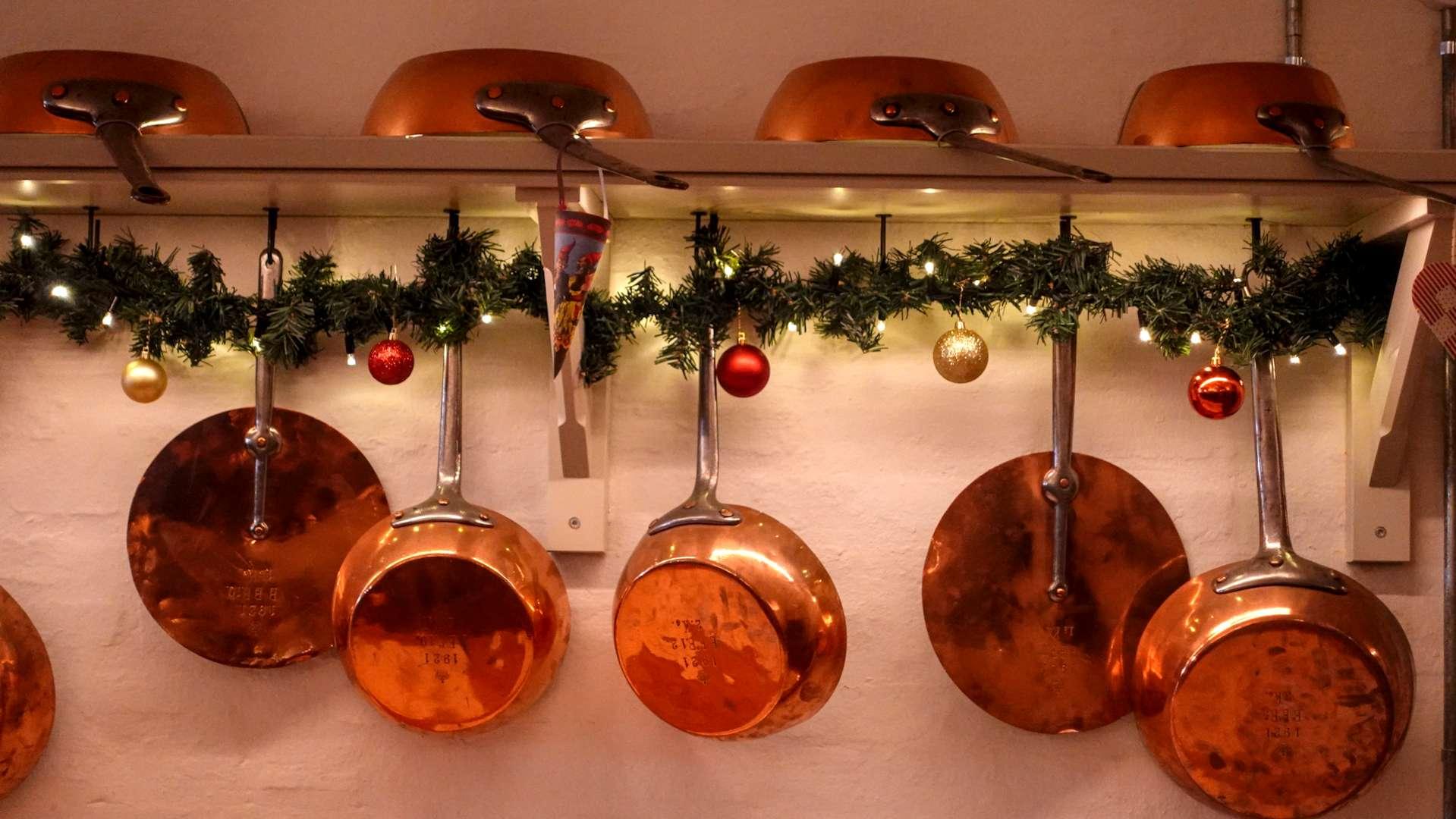
Scandinavian Advent Calendar Day 18

What constitutes a feast? How much abundance crosses into excess, and is there such a thing as indecent indulgence in fine food? These questions resist easy answers, yet they circle around an idea I hold dear: that taste is not merely sensation but education, that pleasure itself can be a form of understanding.
I grew up hearing my mother speak of her favorite film, Babette’s Feast, and for years I assumed it was French cinema—understandably, given the story’s devotion to haute cuisine. Only later did I discover it was Danish, directed by Gabriel Axel, and that it won the Academy Award for Best Foreign Language Film in 1988. What better occasion than this Scandinavian Advent to return to the source: Karen Blixen’s novella that inspired it all.
Baroness Karen Blixen—who wrote in both Danish and English, sometimes under the pen name Isak Dinesen—remains one of Denmark’s most celebrated literary figures. You may know her sweeping memoir Out of Africa, adapted by Sydney Pollack into the film that brought Meryl Streep and Robert Redford to the Kenyan highlands. But Babette’s Feast, published in the collection Anecdotes of Destiny, operates on an entirely different scale: intimate, compressed, deceptively simple.

A short note on how and why I share book links
The story unfolds in a remote Norwegian hamlet (though the film relocates it to the Danish coast). Two elderly sisters, devout and austere, live lives of deliberate simplicity, having long ago renounced worldly pleasures in service of their late father’s strict Lutheran ministry. Into their household arrives Babette, a refugee fleeing the violence of the Paris Commune, whom they take in as cook and housekeeper. For years, Babette prepares their plain meals without complaint. Then she wins the French lottery—ten thousand francs—and announces her intention to use the entire sum to prepare a proper French dinner for the small community that sheltered her.
What follows is a meditation on generosity, artistry, and the relationship between pleasure and the divine. The villagers, suspicious of sensory indulgence, approach the meal with trepidation, having agreed among themselves not to acknowledge or enjoy it. Yet as course after exquisite course arrives—turtle soup, blinis Demidoff, caille en sarcophage—something shifts. Grace enters through the palate. The austere souls gathered around that table find themselves softened, reconciled, reminded of their capacity for joy.


The brevity of the text suits Blixen’s designation of it as an “anecdote of destiny,” and one might be tempted to read it as merely charming entertainment. But the finest literature rarely announces its depth; it reveals itself to those willing to look carefully. Babette’s Feast possesses that essential subtlety, that quality of grace its protagonist embodies. Babette’s life story—her losses, her exile, her ultimate decision to offer what she does best rather than secure her own future—becomes a quiet argument for open-heartedness and the recognition of beauty wherever it appears.

Her practice of gastronomy is revealed not as indulgence but as art, and art itself as a form of devotion. As Blixen writes:
“Through all the world there goes one long cry from the heart of the artist: Give me a chance to do my best.”
Babette’s feast is her masterpiece, given freely, received by people who can barely comprehend what they’re consuming yet are transformed nonetheless.
I found myself thinking of this novella recently in Copenhagen, when my steps led me to a tiny restaurant tucked behind the royal palace—the sort of hidden gem I imagined might have been Babette’s refuge, had she been real. There, served on Royal Copenhagen porcelain, I tasted some of the finest fish of my life: King Frederick’s herring marinated in port, a liver pâté wrapped in salted beef on dense rye bread, bearing the unforgettable name “the vet’s midnight snack.” Accompanied by a Christmas beer from a local brewery, this became my own Danish feast—a Parisian’s education in Nordic flavors. For those moments, my palate connected me to everything a culture distills in its gastronomy: history, landscape, ingenuity, care.
This, I think, is what Blixen understood: that food prepared with artistry and offered with love can become a kind of communion, a way of saying what words cannot express.
Until tomorrow, dear friends—may your feasts be memorable and your hearts open to grace.

Written by Alexandra Poppy
Writer, reader & curator of The Ritual of Reading
I’m Alexandra, the voice behind The Ritual of Reading. Somewhere between a stack of novels and a half-finished pot of tea, I keep finding traces of the life I want to live—slower, richer, filled with stories. The Ritual of Reading is where I gather what I love: books that linger, places with a past, and rituals that make ordinary days feel a little more meaningful. I write from Paris, where elegant bookshops and old-fashioned cafés offer endless inspiration—and I share it here, hoping it brings a spark to your own days, too.